
What Is Making Tax Digital (MTD)? What UK Businesses Need to Prepare For
Managing tax compliance efficiently is a cornerstone of running a successful enterprise in the United Kingdom. Whether you operate a growing startup, work as an independent sole trader, or manage an established limited company, staying compliant with HM Revenue and Customs (HMRC) regulations is crucial to avoiding severe financial penalties and keeping your business operations running smoothly.
Beyond understanding foundational statutory requirements like acquiring a UK business licence, the largest operational change to the UK tax system in recent decades is Making Tax Digital (MTD).
Designed to transform the UK tax administration into a modern, streamlined, and digitalized framework, MTD replaces manual paperwork and traditional annual filings with real-time digital record-keeping and cloud-based submission tools.
This guide breaks down what Making Tax Digital is, the critical phased timelines businesses must follow, and the exact steps required to make your company MTD-compliant.
What Is Making Tax Digital (MTD)?
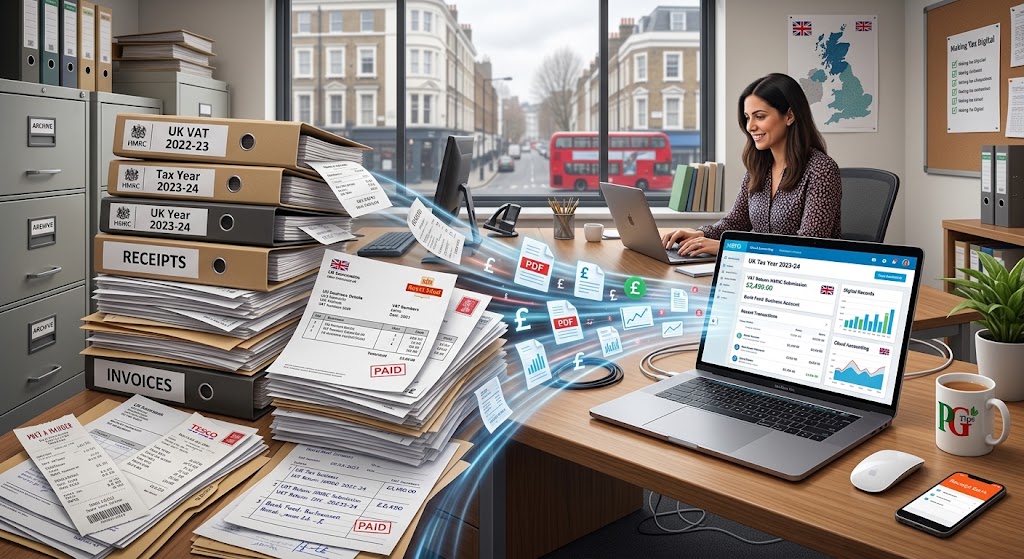
Making Tax Digital is a UK government initiative aimed at making tax administration more effective, efficient, and easier for taxpayers to get right. Under MTD rules, taxpayers are required to keep digital records of their income and expenses using functional, HMRC-compatible accounting software.
According to the GOV.UK guidance on Making Tax Digital for Income Tax, affected sole traders and landlords will need to keep digital records of their income and expenses and submit updates to HMRC using compatible software.
Instead of relying solely on a single end-of-year tax return, affected businesses and self-employed individuals will need to send quarterly updates summarising their income and expenses directly to HMRC through their accounting software.
Why HMRC Introduced MTD
HMRC estimates that avoidable errors—such as manual calculation mistakes, misplaced paper receipts, and delayed logging of invoice records—cost the UK Exchequer billions of pounds annually in lost tax revenues. The key objectives of MTD are:
- Reducing avoidable errors: Automated record-keeping minimizes manual data-entry mistakes.
- Real-time visibility: Business owners gain accurate visibility into their estimated tax liabilities throughout the financial year, eliminating unexpected tax bills.
- Streamlined processing: Eliminates paper filing and provides a direct, secure connection between commercial accounting software and HMRC systems.
The MTD Timeline: Who Is Affected and When?
Making Tax Digital is being rolled out in structured phases based on your entity type and qualifying annual turnover.
1. MTD for VAT (Fully Mandated)
According to the official GOV.UK VAT Notice 700/22, Making Tax Digital (MTD) for VAT requires all VAT-registered businesses to keep their records digitally and submit VAT Returns using compatible software. These requirements have applied to all VAT-registered businesses since April 2022, regardless of their taxable turnover. Businesses must use MTD-compatible software to maintain their digital VAT records and submit their returns to HMRC.
2. MTD for Income Tax Self-Assessment (ITSA)
MTD for Income Tax is being introduced in stages for self-employed individuals, sole traders and landlords with qualifying income. The rules are based on a person’s total gross income before allowable business expenses are deducted.
According to the government’s MTD for Income Tax guidance, the new requirements will come into effect in stages based on qualifying income levels.
| Phase / Start Date | Who It Applies To | Qualifying Annual Income Threshold |
| 6 April 2026 | Sole Traders & Landlords | Gross income over £50,000 |
| 6 April 2027 | Sole Traders & Landlords | Gross income over £30,000 |
| 6 April 2028 | Sole Traders & Landlords | Gross income over £20,000 |
Under MTD for Income Tax, affected individuals must submit four quarterly updates per year via software, followed by a final end-of-year declaration to confirm total income and final tax due.
3. MTD for Corporation Tax
While preliminary consultations were held regarding incorporated limited companies, the UK government has confirmed that MTD for Corporation Tax will not be introduced for the foreseeable future. Limited companies will continue submitting their Corporation Tax returns (CT600) via standard HMRC online portals or through qualified corporate accountants.
How MTD Compliance Works in Practice
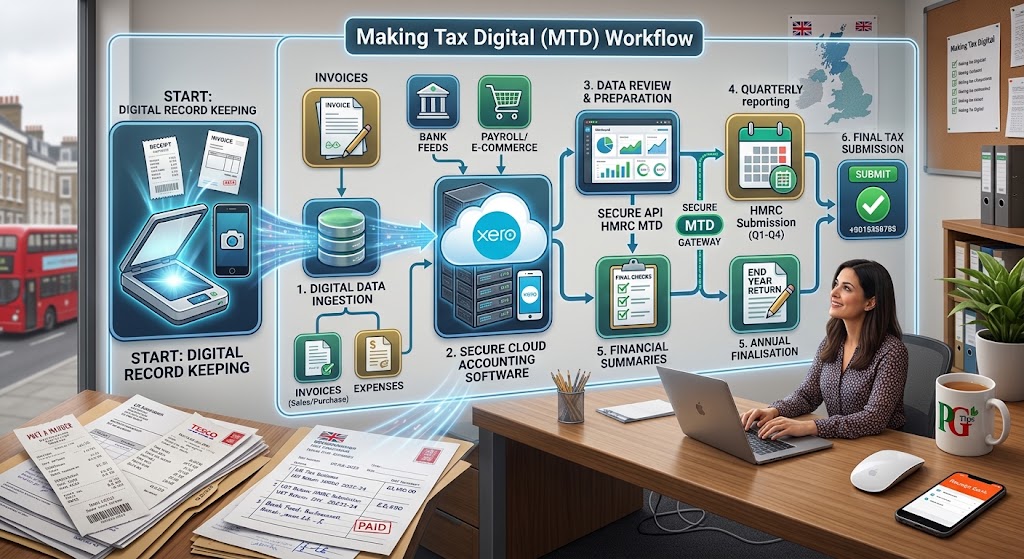
Transitioning to MTD changes your daily accounting workflow. Here is how digital record-keeping works under the MTD operational framework:
- Digital Record Keeping: Paper ledgers and simple standalone spreadsheets without API integrations are no longer compliant. Every sales transaction, invoice, and business expense must be logged digitally.
- Digital Links: The GOV.UK rules on digital links require businesses using more than one software program to ensure that VAT information moves between systems through a digital link. For example, data can be transferred using an API connection, XML or CSV import. Manually copying and pasting figures from one system to another does not meet the digital links requirement.
- Quarterly Reporting: Every three months, your MTD-compatible software generates a summary of your sales and allowable business expenses and securely transmits the totals directly to HMRC.
- Finalizing the Tax Year: At the end of the tax year, you or your accountant submit a final declaration via software to claim allowances, declare additional income sources, and confirm the final tax bill.
Implementing clear financial visibility aligns closely with broader corporate practices such as open book management for financial transparency, ensuring that real-time numbers foster better business decision-making.
5 Essential Steps to Prepare Your Business for MTD
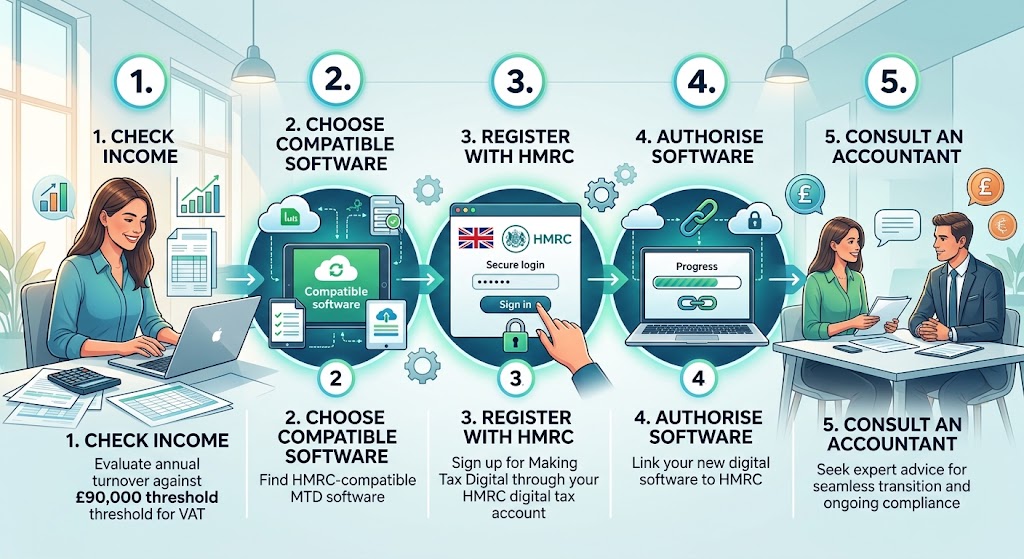
To ensure your business remains compliant and avoids unexpected late submission points or monetary fines, follow these steps:
Step 1: Evaluate Your Qualifying Gross Income
Review your recent Self-Assessment returns or gross turnover records to determine when MTD applies to your business. Remember that the threshold applies to gross revenue, not net profit.
Step 2: Choose HMRC-Compatible Software
HMRC does not provide free software for making MTD submissions. Instead, you need to choose MTD-compatible software that can keep your digital tax records and send the required information to HMRC. For VAT, you can check the official GOV.UK list of compatible VAT software.
Step 3: Register for MTD via GOV.UK
Before submitting data through your software, you must formally register for MTD on the GOV.UK portal using your Government Gateway user ID, National Insurance number, and Unique Taxpayer Reference (UTR).
Step 4: Authorize Your Accounting Software
Once signed up on GOV.UK, log into your cloud accounting platform and authorize it to communicate directly with HMRC’s API servers.
Step 5: Consult an Accredited Professional
Working with a qualified accountant or bookkeeper ensures that your software chart of accounts is configured correctly and that allowable business expense categories are properly mapped before quarterly filing deadlines.
Penalties for Non-Compliance
HMRC uses a points-based penalty system for late MTD submissions. Taxpayers can receive penalty points for missing submission deadlines, and a financial penalty may apply once they reach the relevant points threshold. Separate penalties can also apply when tax payments are made late.
- Late Submission Points: You receive 1 penalty point for each missed filing deadline. Accumulating 4 points triggers an immediate £200 fine, with an additional £200 charged for every subsequent missed deadline.
- Incompatible Software Fines: Submitting tax data through non-compliant methods or failing to maintain digital records can result in financial penalties under HMRC enforcement rules.
MTD and AI: How Technology Is Changing Business Tax Management
Modern cloud accounting software increasingly relies on artificial intelligence and automation to reduce administrative friction:
- Automated Bank Feeds: Transactions are automatically pulled from your business bank account into your accounting ledger every day.
- OCR Receipt Scanning: Using smartphone apps, business owners can snap photos of receipts, allowing AI-based optical character recognition (OCR) to extract amounts, dates, and VAT details automatically.
- Auto-Categorisation: Machine learning algorithms suggest appropriate expense categories (e.g., travel, office supplies, motor expenses) based on historical vendor data.
- Human Verification: While AI accelerates bookkeeping speed, human oversight remains essential to ensure tax categorization meets HMRC allowable expense rules before quarterly submissions.
Benefits and Challenges of MTD
Potential Benefits:
- Fewer Errors: Automated software cuts down on manual calculation mistakes and lost paper invoices.
- Better Financial Visibility: Real-time digital records give business owners immediate insight into cash flow and upcoming tax obligations.
- Streamlined Collaboration: Cloud-based platforms make sharing quarterly numbers with your accountant or bookkeeper fast and secure.
Key Challenges:
- Software Costs: Ongoing monthly subscriptions for commercial cloud software can add operational expenses.
- Learning Curve: Transitioning from paper or basic spreadsheets to cloud accounting requires dedicated setup time and new digital habits.
- Increased Filing Frequency: Moving from one annual submission to four quarterly updates requires disciplined, year-round bookkeeping.
What Does MTD Mean for Sole Traders and Landlords?
For Sole Traders:
Self-employed individuals must track all business turnover and allowable expenses in real time. Using a mobile app to record sales invoices and snap expense receipts on the job keeps your ledger up to date automatically, making quarterly MTD submissions straightforward.
For Landlords:
Property owners who earn rental income across single or multiple properties must log rental payments received and deductible property costs (such as letting agent fees, insurance, and maintenance) digitally. Joint property owners evaluate their individual share of gross rental income against the MTD threshold.
The Future of Making Tax Digital
Making Tax Digital is changing the way businesses and self-employed individuals manage their tax records and report information to HMRC. With digital record keeping, compatible software and regular online submissions becoming an increasingly important part of tax administration, understanding the requirements can help you avoid penalties and keep your tax affairs organised.
Preparing for MTD early can make the transition easier and reduce the risk of errors or missed deadlines. Choosing suitable MTD-compatible software and keeping accurate digital records can also help you manage your finances more efficiently.
If you have additional information or insights about Making Tax Digital that you would like to share, please write to us.
Disclaimer: All information provided was correct at the time of publication and was collected with the help of accredited tools and real-world data insights.

Passionate content designer, contributor and content marketing allrounder at ClickDo.