
Stablecoin Payments for Small UK Businesses: How Customers Pay and What You Receive
Accepting a stablecoin payment involves two connected questions: what does the customer send, and what does the business receive? Perhaps surprisingly, the answers need not be the same.
A customer can pay with a digital token while the business receives conventional currency through a payment service. For a small UK business, understanding that arrangement is more useful than treating every transaction described as a crypto payment identically.
What a stablecoin is

A stablecoin is a digital asset recorded on a blockchain, a shared system for recording transactions. It is designed to track a reference asset, commonly a currency, through a link known as a peg. ICAEW’s explanation of stablecoin features describes this intended relationship and the use of digital wallets, managed by holders or by third parties known as custodians. A peg is a design objective, not a guarantee of constant value. The currency being tracked also needs identifying: a dollar-linked token is not the same as a digital pound.
Understanding the asset through stablecoin deep dives from AlphaWire is separate from understanding how a customer’s payment reaches a business, although the first is often essential to the second. Making sense of what a stablecoin is and how it works will stand small business owners in good stead as they start to interact with the world of crypto. It’s important to recognise that a token’s reference currency describes the value it aims to track; it does not determine which currency reaches the merchant’s bank account. That depends on whether conversion is included and how the payment service delivers the proceeds.
How a customer makes the payment

The process starts with a payment request from any web platform or e-commerce marketplace. This can take the form of a checkout, invoice, or payment link, rather than a business simply publishing a wallet address. The request identifies what the customer must send and where it must go. The accepted token and the blockchain network are separate details: naming an asset alone does not fully describe the supported payment route. A wallet is the customer’s means of managing and sending the tokens, while the network carries the transfer.
Transak’s explanation of stablecoin pay-ins sets out the general sequence. The customer authorises the transfer from their wallet using an accepted asset and network. The receiving system checks that the asset, network, destination address, and amount match the request, and that the transfer has reached the confirmation stage the service requires. It connects the incoming transfer with the payment request, so the business can update the order or invoice.
This gives the business a payment status associated with a particular sale. A blockchain transfer records movement of the token; the checkout or invoice system supplies the commercial context. The two records serve different purposes. Matching them lets the business identify the sale being paid for. Providers describe a payment coming into a business as a ‘pay-in.’ That term identifies its direction, without deciding whether the merchant ultimately keeps the token.
What your business receives
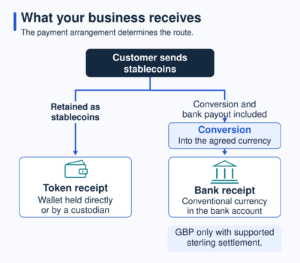
There are two broad outcomes: the business receives stablecoins, or the payment arrangement converts them into conventional currency. The customer’s choice at checkout does not, by itself, establish which outcome applies. Nor does displaying a stablecoin payment option mean that the merchant manages a wallet directly. Instead, there are two options:
- With token receipt, the proceeds remain a digital asset. They may be held in a wallet controlled by the business or through a custodian holding tokens on its behalf. The business has received tokens, rather than a credit in its ordinary bank account. Any subsequent conversion into conventional currency is a separate part of handling those proceeds.
- With conversion, the payment arrangement exchanges the received asset before making the agreed payout. Where sterling conversion and bank settlement are supported, the business receives pounds in the nominated account. That description depends on the actual service: accepting a dollar-linked stablecoin does not establish that a provider offers GBP settlement to UK businesses. Conversion and payout are separate operations, even when one service handles both. Conversion changes the asset or currency held; payout delivers the resulting proceeds to the agreed destination.
The reference currency, conversion currency, and receiving account therefore need to be read separately. They are different forms of information, even though a payment service may connect them within one transaction process.
A dollar peg also does not fix a token’s sterling value. The relationship between dollars and pounds still applies when translating a dollar-denominated value into GBP. Describing a token as stable therefore leaves an essential question unanswered for a UK business: stable against which currency? The answer lies with the peg, rather than the eventual payout.
Reading the settlement arrangement
A useful description of the service should identify the accepted asset and network, the form of receipt, and the destination for the proceeds. “Stablecoin payments supported” answers only part of the question. Tokens held in a wallet and pounds credited to a bank account are different receipts. A balance shown within a payment service needs its own currency label and payout terms.
The arrangement should also make clear who handles conversion and where it occurs in the process. Receiving tokens and later exchanging them is operationally different from receiving a bank payout after the service has converted them. Neither description, on its own, establishes a fee, exchange rate, or delivery time.
For the business, the process is understood when the customer’s transfer can be connected to the sale and then followed through to the actual receipt. The asset sent, any conversion, and the final receiving account together explain what accepting that payment means.

WordPress website developer and content writer for online blogs. I also love to create content on YouTube and other popular platforms.