
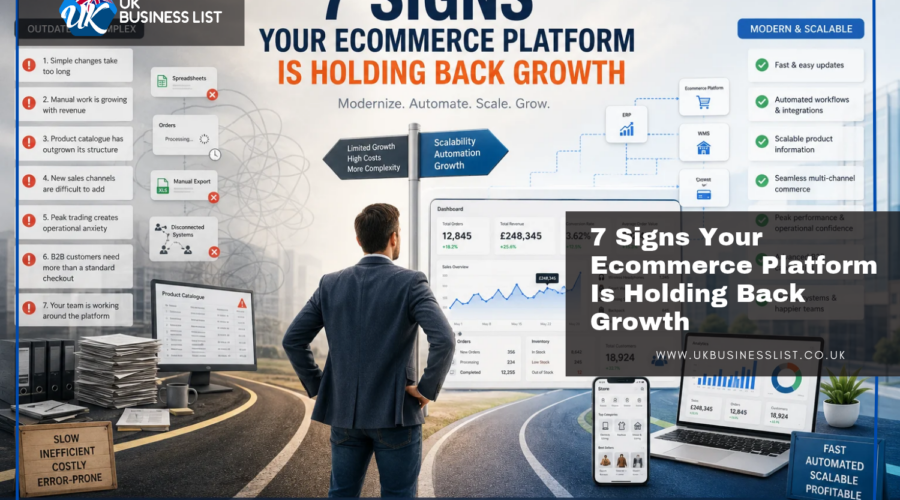
7 Signs Your Ecommerce Platform Is Holding Back Growth
An ecommerce platform can help a business grow – until the systems, processes and customer experience around it become more complex than the original setup was designed to handle. Here are seven signs that it may be time to rethink your ecommerce technology.
For many businesses, an online store begins relatively simply: a manageable product catalogue, a few payment methods, standard delivery options and a straightforward checkout.
Growth changes that.
More products create more data. New sales channels introduce additional integrations. International expansion adds currencies, languages, tax rules and fulfilment requirements. Marketing teams want greater control over promotions and content, while customers expect increasingly convenient digital experiences.
At this stage, ecommerce technology stops being merely a place to display and sell products. It becomes part of the company’s operational infrastructure.
The important question for business owners is therefore not simply, “Does our website still work?” It is:
“Can our current ecommerce setup support where the business is going next?”
Here are seven warning signs worth watching.
1. Simple Changes Take Too Long

Adding a new promotion, changing a product attribute or creating a landing page should not become a miniature IT project.
Yet this often happens as ecommerce systems age.
Marketing teams may depend on developers for routine changes. Product managers may maintain information manually across several systems. Even small checkout updates can require lengthy testing because nobody is entirely sure what else they might affect.
Individual delays can appear minor, but together they reduce business agility.
Consider how quickly your team can:
- Launch a seasonal promotion
- Add a new product category
- Update pricing across multiple products
- Create customer-specific offers
- Change delivery options
- Introduce new content
- Test a different purchasing journey
If routine commercial changes repeatedly enter a development queue, the technology may no longer be supporting the business efficiently.
2. Manual Work Is Growing With Revenue
Business growth should not require administrative work to increase at exactly the same rate.
Imagine an ecommerce company processing a few hundred orders per month. Manually updating certain records may initially seem perfectly manageable.
Multiply that volume several times, however, and the same process becomes expensive and error-prone.
Growing retailers frequently encounter manual work around:
- Stock control and updates
- Order processing
- Product information
- Customer data
- Returns
- Supplier information
- Pricing
- Shipping
- Accounting
The problem is rarely the ecommerce platform alone. It is usually the way different systems communicate.
An established online business might have an ecommerce platform connected to an ERP, CRM, warehouse system, payment providers, marketplaces, analytics tools and marketing software.
When those connections are weak, employees become the integration layer.
They export spreadsheets, copy information between platforms and manually correct inconsistencies that should have been handled automatically.
That is a scalability warning.
3. Your Product Catalogue Has Outgrown Its Original Structure

A catalogue containing 100 simple products is very different from one containing thousands of SKUs, variants, configurable products, bundles or customer-specific prices.
As the catalogue expands, product management can become one of the biggest operational challenges in ecommerce.
Typical symptoms include:
- Duplicate product information
- Inconsistent attributes
- Difficult catalogue navigation
- Slow product updates
- Incorrect availability
- Complicated category structures
- Pricing discrepancies
- Poor search relevance
The customer sees only the final storefront, but behind it may be a complicated network of product data and business rules.
This is one area where platforms such as Magento can become valuable for businesses with more sophisticated commerce requirements. The platform can support extensive catalogues and custom workflows, but the architecture still needs to reflect how the business actually operates.
For companies reaching that stage, working with an experienced magento development agency can help determine whether existing functionality should be optimised, integrated differently or redesigned around changing commercial requirements.
The objective should not be adding technology for its own sake. It should be reducing operational friction.
4. New Sales Channels Are Difficult to Add
Customers no longer necessarily arrive through one storefront.
A business may sell through its primary ecommerce website while also operating marketplaces, mobile experiences, social commerce channels, physical locations or separate B2B portals.
That creates a fundamental technology question:
Where does the source of truth live?
If every new channel introduces another independent set of inventory, customer or product data, complexity grows quickly.
A scalable ecommerce architecture should make it possible to connect channels without rebuilding the entire operation each time.
For example, product information may need to flow consistently between the main catalogue and multiple sales channels. Inventory should reflect purchases regardless of where the transaction occurs. Customer service teams should ideally be able to understand the customer’s relationship with the business without searching several disconnected systems.
When adding a new channel feels disproportionately difficult, the underlying architecture deserves attention.
5. Peak Trading Creates Operational Anxiety

Strong sales periods should create commercial opportunity rather than technical uncertainty.
Yet many online retailers approach major campaigns with a familiar set of concerns:
Will the website remain responsive?
Will stock information stay accurate?
Will payments process correctly?
Will promotions behave as expected?
Can fulfillment cope with the additional volume?
Some pressure during major trading periods is unavoidable, but repeated concern about whether the ecommerce operation can withstand business success indicates a deeper issue.
Preparation should therefore extend beyond marketing.
Before important campaigns, businesses should review:
- Store performance
- Checkout functionality
- Payment integrations
- Inventory synchronisation
- Promotional rules
- Search
- Order processing
- Monitoring
- Recovery procedures
The objective is not to eliminate every possible technical risk. It is to understand critical dependencies before revenue depends on them.
6. B2B Customers Need More Than a Standard Checkout
For companies selling to other businesses, ecommerce requirements can become substantially more complicated.
A consumer may simply select a product, enter payment information and complete the order.
A commercial customer might need:
- Contract pricing
- Company accounts
- Multiple authorised buyers
- Purchase orders
- Approval workflows
- Credit limits
- Custom catalogues
- Quotes
- Repeat ordering
- VAT documentation
Trying to force these requirements into a standard retail journey can create unnecessary work for both customers and employees.
Sales teams may end up processing orders manually that customers would prefer to manage online. Account managers may spend time answering pricing or availability questions that could be handled through customer-specific portals.
At this point, digital commerce becomes an operational efficiency opportunity, not merely another sales channel.
The right ecommerce architecture can allow customers to perform routine tasks independently while keeping sales teams focused on higher-value relationships.
7. Your Team Is Working Around the Platform

Perhaps the clearest warning sign is when employees have invented their own processes because the official system no longer fits their needs.
These workarounds might include private spreadsheets, manual exports, temporary databases, duplicated reports or information stored outside the primary ecommerce environment.
Individually, each workaround may appear harmless.
Collectively, they often reveal where the business has changed faster than its technology.
Ask different teams a simple question:
“What part of our ecommerce operation creates unnecessary work every week?”
Ask sales.
Ask marketing.
Ask customer service.
Ask finance.
Ask warehouse staff.
Ask the development team.
Their answers may reveal problems that are invisible when ecommerce performance is judged only by whether orders are still arriving.
What Should a Growing Business Do Next?
Finding several of these warning signs does not automatically mean the company needs a complete replatforming project.
Replacing an ecommerce platform can be expensive and disruptive, and sometimes the existing system is entirely capable of supporting further growth.
The better starting point is an audit.
Review the current ecommerce operation from three perspectives:
Commercial: What does the business want to achieve over the next few years?
Operational: Which processes consume unnecessary time or create repeated errors?
Technical: Which systems, integrations or architectural decisions are preventing improvement?
From there, businesses can prioritise changes according to commercial impact.
Some may require relatively small improvements. Others might involve integration work, automation, performance optimisation or a broader architecture redesign.
Only when the limitations of the current platform fundamentally conflict with future requirements should migration become the primary option.
Build for the Business You Are Becoming
One of the biggest mistakes in ecommerce technology is solving only today’s problem.
A platform may work perfectly for the company’s current size while creating significant constraints at the next stage of growth.
That does not mean businesses should overengineer systems in anticipation of every possible future scenario. It means technology decisions should leave enough flexibility for reasonable change.
The strongest ecommerce platforms are not simply fast storefronts.
They help teams launch products faster, reduce repetitive work, connect business systems, support new sales models and give customers easier ways to buy.
When ecommerce technology begins doing the opposite – slowing teams down, creating manual processes and making growth more difficult – it is worth investigating why.
Because ultimately, the best ecommerce technology should become less noticeable as the company grows, not more.

CEO – ClickDo™ & SeekaHost™ | #1 Digital Nomad & Web Consultant in the UK | Founder – UK Business List – UK Business Blog & many more Online Businesses