
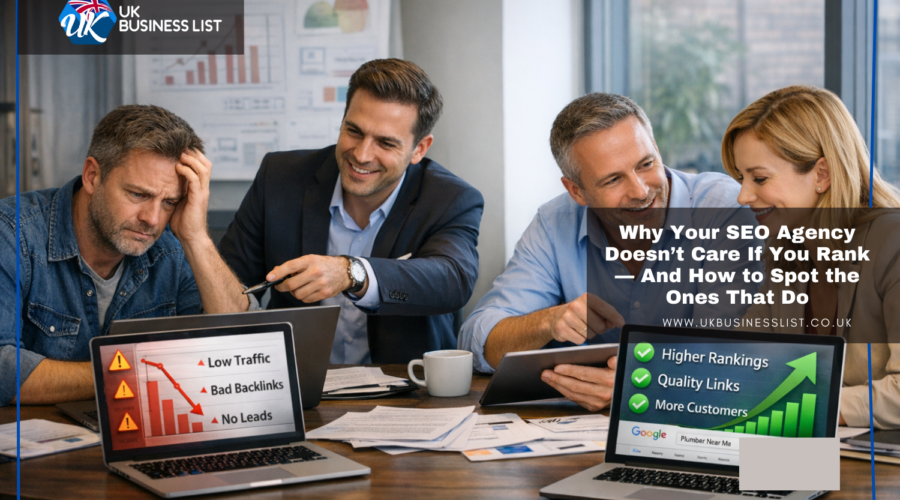
Why Your SEO Agency Doesn’t Care If You Rank — And How to Spot the Ones That Do
Opinion Piece by Simon — Founder, Get Your Website Seen
A business owner came to me last year with a familiar story. He’d been paying an SEO agency £400 a month for eighteen months. That’s over seven grand, when you add it up. On top of that, he’d spent thousands more on landing pages they’d recommended. Professional-looking pages, fair play to them. Nicely designed.
The problem? He still couldn’t be found in his own town. Not for his main service. Not for his business name in some cases. Eighteen months and thousands of pounds later, and his target customers were finding his competitors instead.
When he showed me the reports his agency had been sending him, it all made sense. They were full of graphs going up and to the right — impressions, clicks, backlink counts. It looked great on paper. But none of it translated into actual enquiries, actual phone calls, or actual customers walking through his door.
That conversation was the moment it properly clicked for me. This wasn’t just one bad agency. This was an industry-wide problem.
The Dirty Playbook
Here’s how the playbook works, and it’s depressingly common.
An agency signs up a small business. They promise first-page rankings, more traffic, more leads. The business owner, who quite rightly doesn’t know the ins and outs of SEO, trusts them. Why wouldn’t you? They’ve got a nice website themselves, maybe a few testimonials, and they talk a good game.
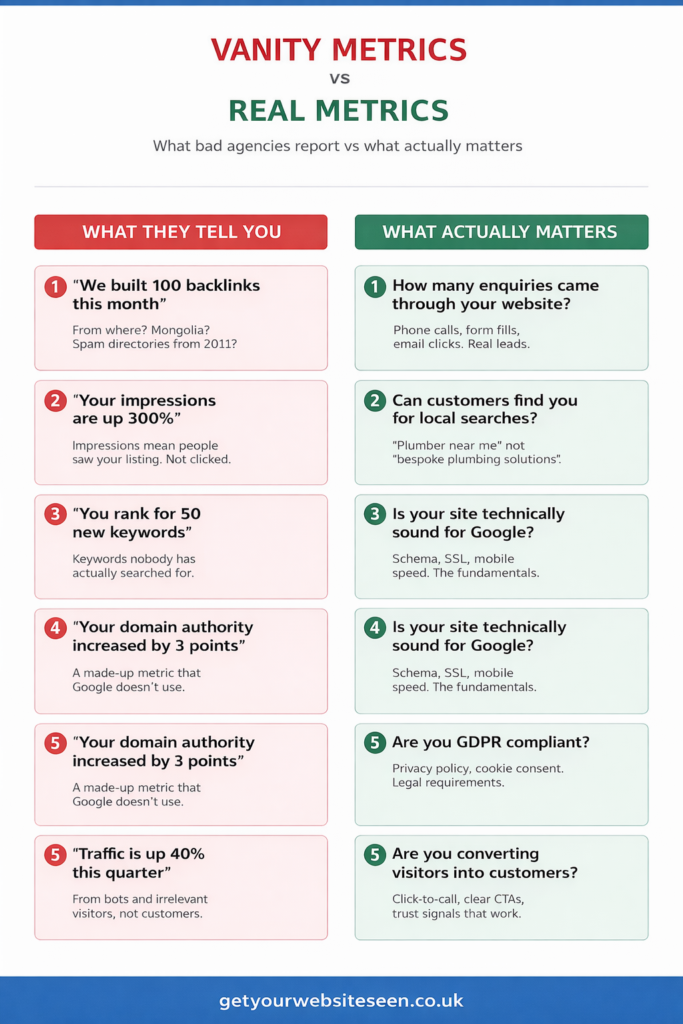
Then the “work” begins. And by work, I mean the bare minimum dressed up as progress. You get monthly reports stuffed with vanity metrics — numbers that look impressive but mean almost nothing. “We built 100 backlinks this month.” Brilliant. From where? Mongolia? Random directories nobody has visited since 2011? A backlink from a spam site doesn’t help you rank in Coventry or Crawley or wherever your customers actually are. It can actively hurt you.
They’ll throw in some keyword rankings too. “You’re now ranking for ‘professional bespoke artisan cleaning solutions.’” Lovely. Nobody has ever searched for that. Not once. But it’s on the report, the graph goes up, and the client thinks something is happening.
What they almost never do is take the time to understand the business. Who are your customers? What do they actually type into Google when they need what you offer? What does your local competition look like? These are basic questions, and most agencies never bother asking them because the answers don’t matter to their business model.
The Churn Machine
Because that business model is beautifully simple, if you’re the agency. Sign up a client. Lock them into a monthly retainer. Do just enough to fill a report every month. Ride it for six months, maybe twelve if the client is patient. When they eventually start asking awkward questions — “Why am I not getting any more enquiries?” — you stall, bamboozle them with jargon, or quietly let them drift away.
Then you sign the next one. Rinse and repeat.
The client is just a line on a spreadsheet. They’re not a joiner in Leeds trying to grow his business, or a cleaning company in the Midlands trying to compete with the big franchises. They’re £400 a month until they wise up. And honestly, a lot of agencies are banking on the fact that most small business owners are too busy actually running their business to dig into what’s really going on.
I’ve spoken to dozens of business owners who’ve been through this. The story is almost always the same: they spent money, they got reports, they saw no real difference, and they came away thinking “SEO doesn’t work.” It does work. It just wasn’t being done properly.
What Small Businesses Actually Need

Effective SEO for a small business isn’t complicated, but it does require someone to actually care about the outcome. It starts with understanding the business — properly. What do you do, where do you do it, and who are you trying to reach?
From there, it’s about focusing on the searches that matter. Not vanity keywords, not long-tail phrases nobody types — the real searches that real people in your area are making when they need your service. “Plumber near me.” “Cleaning company Coventry.” “Builder in Hampshire.” That’s where your customers are.
Then it’s the fundamentals. Is your site technically sound? Does Google actually understand what you do and where you do it? Is your Google Business Profile set up properly? Have you got the right schema markup so search engines can make sense of your pages? These aren’t glamorous, and they don’t make for exciting reports, but they’re what actually moves the needle.
Quality over quantity. Every single time. One relevant, authoritative backlink from a genuine local source is worth more than a hundred from overseas spam directories. A well-written page that answers the questions your customers are actually asking will outperform ten pages of keyword-stuffed nonsense.
How to Protect Yourself
If you’re currently paying for SEO, or thinking about it, here are a few things worth keeping in mind.
Ask where your backlinks are coming from. If your agency can’t give you a straight answer, or the links are from sites you’ve never heard of in countries your customers don’t live in, that’s a problem. Ask what keywords you’re ranking for and then search for them yourself. If nobody would ever actually type those phrases into Google, the rankings are meaningless.
Ask your agency to explain your results in plain English — not impressions, not clicks, not bounce rates. How many enquiries came through your website this month compared to last month? How many people called the number on your site? If they can’t answer that, or they redirect you back to vanity metrics, take note.
Look at whether they’ve taken the time to understand your business. Have they asked about your customers? Do they know what services you want to push? Have they looked at your competitors? If the first conversation was mostly about their packages and pricing rather than your business, that tells you where their priorities are.
And finally — be wary of long contracts. A good agency doesn’t need to lock you in for twelve months. If the work is good, you’ll stay because it’s working. Not because you’re contractually obliged to.
Why We Do Things Differently
I’ve built and sold three businesses over the years, including a tech company that held the number one Google ranking worldwide in its market. I know what visibility does for a business, and I know what it costs when you don’t have it. My wife Lisa and I set up Get Your Website Seen because we were tired of watching small businesses get taken for a ride by agencies that were in it for the retainer, not the result.
We work exclusively with UK small businesses. We build our own tools. We focus on what actually drives enquiries, not what looks good in a report. If you want to know where your website really stands, we offer a free SEO audit — no jargon, no hard sell. Just an honest look at what’s working and what isn’t.
About the Author
Simon is the founder of Get Your Website Seen (GYWS), a UK SEO and digital marketing agency that works exclusively with small businesses across Britain. With a background that includes building and selling three businesses — one of which achieved the number one Google ranking worldwide — Simon brings hands-on experience and a no-nonsense approach to helping businesses get found online. He runs GYWS alongside his wife Lisa, and their focus is simple: real results for real businesses, with none of the industry waffle.
