
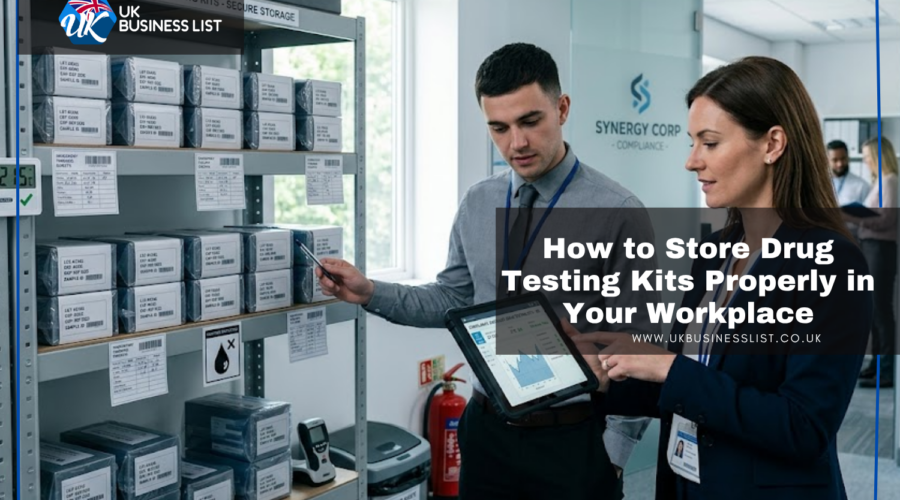
How to Store Drug Testing Kits Properly in Your Workplace
If your workplace uses drug testing kits, you already understand how important accurate results are.
But here is something many employers overlook: even the best-quality kit can produce unreliable or invalid results if it has not been stored correctly.
Poor storage leads to degraded reagents, compromised test strips, and false outcomes that could put your business and your people at risk.
This guide walks you through exactly how to store drug testing kits properly, so every test you run reflects the standard your workplace deserves.
Why Proper Storage of Drug Testing Kits Matters

Drug testing kits are precision diagnostic tools, not just simple items you tuck away in a desk drawer. Each kit contains chemical reagents and immunoassay components calibrated to react in a very specific way. Exposure to the wrong conditions, even briefly, can alter those components at a molecular level. The result? A test that gives you inaccurate data, which is far worse than no test at all.
For businesses across the country, using Drug Testing Kits UK regulations and occupational health standards require that test results stand up to scrutiny. If a result is ever challenged, the integrity of how those kits were stored will come into question. Inadequate storage is one of the most common reasons test results get disputed or dismissed entirely.
Beyond legal and procedural concerns, there is also a straightforward duty of care at play. You have a responsibility to your workforce to conduct accurate, fair testing. A kit stored in poor conditions does not just waste money: it undermines trust in your entire drug testing programme. Proper storage is not a minor administrative detail. It is the foundation that every reliable test result rests on.
Ideal Temperature and Environmental Conditions
Most drug testing kits are designed to be stored at room temperature, typically between 2°C and 30°C, though many manufacturers recommend a narrower range of 4°C to 25°C. Always check the specific storage instructions printed on the packaging of the kits you use, as different product lines may have slightly different requirements. What remains consistent across almost every type of kit is that temperature extremes are damaging in both directions.
Excessive heat accelerates the degradation of chemical components inside the kit. A kit left in a hot vehicle, near a radiator, or in a sun-exposed storage room can deteriorate rapidly. On the opposite end, freezing temperatures cause condensation and physical damage to test membranes upon thawing. Neither scenario leaves you with a kit you can trust.
Your storage area should maintain a stable, consistent temperature year-round. Avoid spots near windows, exterior walls, or heating units. A climate-controlled room or a dedicated cupboard in an internal area of the building is a practical and effective choice for most workplaces.
Protecting Kits from Light, Humidity, and Moisture
Temperature is only part of the equation. Light exposure, particularly direct sunlight or UV light, breaks down the reagents in drug testing kits over time. Even indirect, prolonged exposure to bright artificial lighting can have a gradual effect. Store kits in a dark cupboard or an opaque container to keep them properly shielded.
Humidity and moisture are equally problematic. High humidity causes test strips to absorb ambient moisture from the air, which interferes with how the reactive zones function during a test. This is why you should never store kits in bathrooms, kitchens, near sinks, or in any area prone to condensation.
The ideal relative humidity for storage is generally below 60%. If your workplace is in a region or environment where humidity tends to run high, consider using silica gel desiccant packs inside your storage container to absorb excess moisture. Keep the original sealed packaging intact for as long as possible. Once a kit is removed from its foil pouch or sealed wrapper, its shelf life shortens considerably. Only open a kit immediately before use, never in advance.
Packaging, Sealing, and On-Site Organisation

Good organisation within your storage area does more than keep things tidy. It directly supports the reliability of your testing process. Kits should always be stored in their original, sealed packaging until the moment they are needed. The original packaging is specifically designed to protect the contents from environmental exposure. Repackaging kits into generic containers, bags, or boxes removes that layer of protection and voids any manufacturer guidance.
Designate a specific, clearly labelled storage location for your drug testing kits. This location should be accessible to authorised personnel only. Restricting access reduces the risk of kits being moved, mishandled, or accidentally exposed to unsuitable conditions. It also maintains a clear chain of custody, which matters significantly if test results are ever subject to review.
Use a proper labelling system so that anyone responsible for your drug testing programme can identify kits quickly, check stock levels, and note expiry dates at a glance. A simple log or inventory sheet stored nearby for stock control, whether physical or digital, is an easy habit to adopt. Separate kits by batch or purchase date so that older stock is always used before newer deliveries. Avoid stacking heavy items on top of packaged kits, as physical pressure can damage delicate internal components. Keep the storage area clean, dry, and free from chemical fumes or strong odours, which in rare cases can interact with sensitive test materials.
Managing Expiry Dates and Stock Rotation
Every drug testing kit carries an expiry date, and that date is not a rough suggestion. It represents the point beyond which the manufacturer can no longer guarantee the accuracy of the test. Using an expired kit introduces unnecessary risk and is something no responsible workplace should do, regardless of how the kit looks on the outside.
The best way to stay on top of expiry dates is to adopt a first-in, first-out (FIFO) rotation system. Place newly delivered stock at the back of the storage area and bring older stock to the front. This simple practice, borrowed from standard stock management, means your team will naturally reach for the oldest kits first and reduces the chance of any batch sitting unused until it expires.
Conduct a regular stock audit, ideally monthly or quarterly depending on how frequently your workplace carries out drug tests. During each audit, check expiry dates on all kits in storage, remove any that have passed their date, and record what was disposed of. This keeps your inventory accurate and your testing programme compliant.
If you notice that kits are consistently expiring before use, it is worth reassessing how many you order at a time. Over-ordering might feel cost-effective, but it becomes a false economy if kits regularly go to waste. Ordering smaller quantities more frequently is a smarter approach for many workplaces. Some suppliers also offer batch-specific expiry information, so ask for that detail at the point of purchase to plan your stock levels more accurately.
An effective Storage Procedure is the best Safeguard
Storing drug testing kits correctly is not complicated, but it does require consistent attention. Keep kits in stable temperatures, away from light and moisture, in their original sealed packaging, and well-organised by expiry date. These steps protect the integrity of every test you conduct and reflect the standard of professionalism your workplace drug testing programme should represent. Get the storage right, and the results you rely on will be results you can actually trust.

WordPress website developer and content writer for online blogs. I also love to create content on YouTube and other popular platforms.