
Which Car Features Are Worth Paying For?
You are looking at a long options list, and it can be difficult to tell which extras will improve daily driving and which simply look good on the specification sheet.
Options can quickly increase the purchase price, especially when several are bundled into one trim level. If you are comparing finance through a broker such as Car Plus, it is worth checking how that higher price changes the monthly payment and total amount repayable.
With the overall cost in mind, I would prioritise automatic emergency braking, blind-spot monitoring, good headlights, parking assistance, phone connectivity and comfort features you will genuinely use.
Start With the Features You Will Actually Use
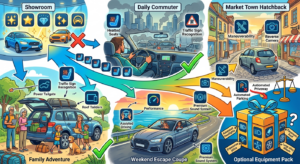
The features worth paying for are the ones that match how you actually drive — everything else is secondary, however impressive it looks in the showroom. Someone commuting into a city has different needs from someone driving a small hatchback around a market town, and a family carrying children will value different equipment from a couple buying a weekend car.
Frequency is the key test. Paying extra for heated seats makes sense when you’ll use them every cold morning — spending the same amount on automated parking makes less sense if you have a driveway and rarely park in town.
Optional equipment often comes bundled into expensive packs, too. The one feature you actually want may sit alongside a panoramic roof, decorative lighting and larger wheels. We’d weigh the price of the whole package before the price of the one feature — you’re paying for everything in it.
Pay First for Safety Features

Safety technology is worth paying for before any cosmetic upgrade. The most useful systems work quietly in the background and step in during the one moment a driver misses something.
We’d rank these as the features that pay off most consistently:
- Automatic emergency braking
- Blind-spot monitoring
- Rear cross-traffic alert
- Rear automatic braking
- Bright, effective LED headlights
- Driver-attention monitoring
Automatic emergency braking (AEB) can apply the brakes when the car detects an approaching vehicle, cyclist or pedestrian. Thatcham Research found AEB cut real-world rear-end crashes by 38%, and a separate insurance study recorded a 45% drop in third-party injury claims where manufacturers fitted it as standard.
Blind-spot monitoring is another feature that’s easy to miss once you’re used to having it. The warning light in the mirror adds another layer of information on busy motorways and crowded dual carriageways — checking your mirrors and looking over your shoulder still matters, but the extra warning can catch a vehicle hidden at exactly the wrong angle.
Some systems are more irritating than useful. Lane-departure warnings can beep too often on narrow British roads, and overactive speed warnings soon become tiresome. A 2025 Thatcham survey still found that 82% of UK drivers felt safer with driver-assistance technology overall, even though nearly a quarter found some features distracting or intrusive.
Choose Parking and Visibility Aids
Parking sensors are worth having on almost any modern car — thick pillars, high window lines and large body panels have made many new vehicles surprisingly hard to judge from the driver’s seat.
A reversing camera adds useful visibility, particularly when children, pets or low objects could be behind the car. A 360-degree camera goes further by building a full view around the vehicle, which tends to matter more in a large SUV than in a compact car with good visibility already.
| Feature | Where it earns its keep | Worth it? |
| Rear parking sensors | Tight bays and low obstacles | Worth having on most cars |
| Reversing camera | Poor rear visibility | Usually worth the upgrade |
| Front parking sensors | Long cars and high bonnets | Helpful in towns |
| 360-degree camera | SUVs and narrow car parks | Valuable on larger vehicles |
| Automated parking | Occasional parallel parking | Clever, though rarely essential |
| Rear automatic braking | Busy car parks and driveways | A strong safety upgrade |
Camera quality matters more than screen size. A sharp image that works properly at night is far more useful than a huge display with a grainy picture — so it’s worth checking how quickly the camera appears after selecting reverse, and whether rain leaves the lens unusable.
Add Comfort Features You Will Notice Every Day
Comfort features pay off when you’ll notice them on an ordinary day, not just on a test drive. Heated seats are one of the easiest upgrades to justify — they warm you directly, work quickly and make cold mornings less miserable, while a heated steering wheel earns its place on a frosty January commute.
Ventilated seats matter less in the UK, though they can be welcome during warmer weather or on long journeys. Automatic climate control is more broadly useful, since it maintains a set temperature without constant adjustment — dual-zone control is worth having if you and a passenger regularly disagree about cabin temperature.
Seat quality deserves more attention than the number of electric adjustments. A supportive manual seat beats an elaborate electric one with the wrong shape. Try the driving position for longer than a few minutes, especially if back or leg discomfort is a concern.
A panoramic roof is harder to judge. It brightens a dark cabin and can make the rear seats feel less enclosed, but it may also reduce headroom, add weight and make the interior hotter in summer. We’d call it one worth experiencing as a passenger before you commit to it as a buyer.
Pick Simple Technology and Connectivity
Smartphone connectivity is one of the most useful features in a modern car. Apple CarPlay and Android Auto give you familiar navigation, music and messaging apps without learning another manufacturer’s software.
Wireless phone connectivity is convenient when it works reliably, while a wired connection is less elegant but normally gives a stable link and charges the phone at the same time. A smaller, responsive screen with physical temperature controls can be a better choice than a vast touchscreen crammed with every basic function.
Built-in satellite navigation has lost some of its appeal, since phone maps update frequently and include live traffic information. It can still earn its place in areas with poor mobile reception, especially where the system can display directions in the instrument panel or a head-up display.
Subscription charges deserve scrutiny, though. Heated seats, connected navigation, remote locking and other functions can require ongoing payments on certain cars — a reasonable purchase price looks a lot less attractive once basic features come with recurring costs.
Consider Highway and Long-Trip Features
We’d rate adaptive cruise control as worth having for regular motorway driving. It maintains your chosen speed and adjusts the gap to the car ahead, cutting down the constant cycle of braking and accelerating in moderate traffic.
The quality varies a good deal between systems. A smooth system feels natural, while a nervous one brakes too sharply whenever another vehicle enters your lane — a proper test drive tells you far more than the brochure ever will.
Lane centring can reduce fatigue too, although you remain responsible for steering and watching the road. The language marketers use to sell driver-assistance technology sometimes promises more than it delivers. Thatcham previously found that 52% of UK drivers mistakenly believed fully autonomous driving was already available, which shows how easily the distinction gets blurred.
Upgraded headlights can be a better investment than either system. Good LED or adaptive lights improve visibility on wet, unlit roads where older halogen lamps can feel weak — actual performance is worth checking rather than assuming every LED setup is equally good.
Be Careful With Expensive Extras
Large alloy wheels are worth thinking twice about, however good they look in the showroom. They often bring a firmer ride, more road noise and pricier replacement tyres.
Low-profile tyres are also less forgiving when they meet one of Britain’s many potholes.
Premium audio earns its price if you listen closely and spend plenty of time in the car. Otherwise, road and wind noise can mask much of the improvement.
A few other extras follow the same logic — enjoyable, but not essential:
- Sports exhausts
- Coloured ambient lighting
- Elaborate driving modes
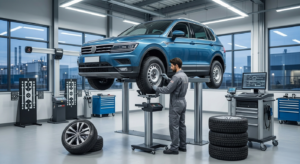
Advanced sensors bring one more consideration. Cameras and radar units that support ADAS (Advanced Driver Assistance Systems) may need careful repair or recalibration after a windscreen replacement or collision.
Thatcham’s UK insurance-industry requirements state that ADAS repairs should follow vehicle-manufacturer standards. That means sophisticated equipment can affect future repair costs as well as the purchase price.
Where the Money Is Best Spent
We’d prioritise the safety and comfort features first — AEB, blind-spot monitoring, parking sensors, a reversing camera, effective headlights, adaptive cruise control, heated seats and straightforward phone connectivity.
Giant wheels, automated parking and decorative technology are easier to live without. Trying the actual options on a test drive, rather than just reading the spec sheet, is the surest way to tell which ones will matter to you.

CEO – ClickDo™ & SeekaHost™ | #1 Digital Nomad & Web Consultant in the UK | Founder – UK Business List – UK Business Blog & many more Online Businesses