
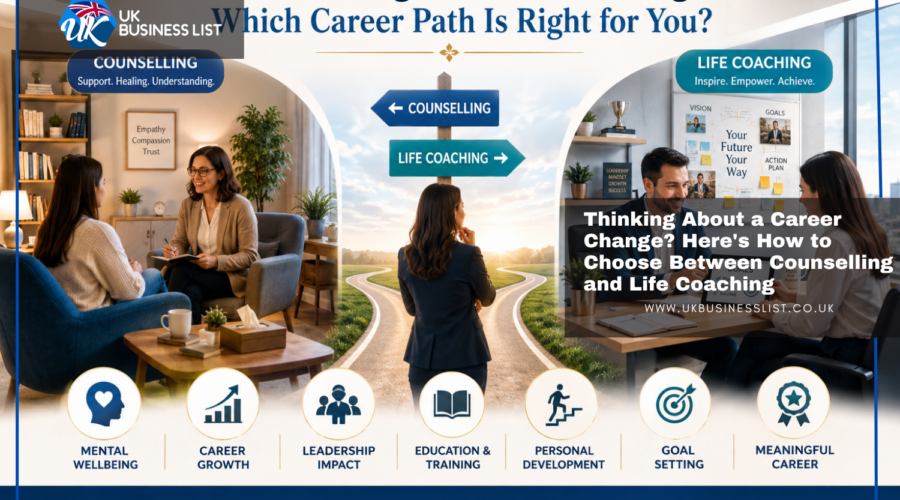
Thinking About a Career Change? Here’s How to Choose Between Counselling and Life Coaching
You’ve spent years in a career that pays the bills, maybe even one you’ve been decent at, but recently, something’s shifted in you.
You want work that involves real conversations, actual impact, and people leaving better than they arrived. Overall, more than anything else, you want your work to mean something, and you want to help people.
If that describes you, you’ve probably already looked at two options: counselling and life coaching.
The Core Distinction
As experts at The Coaching Academy know, from the outside they’re easy to confuse; both involve listening closely and supporting someone through change. The differences between the two are daily important to identify – ideally before you start spending money on training.
Counselling looks backwards; coaching looks forwards.
Counselling helps people understand how their past is shaping their present. It’s slow, deep work in which clients explore difficult feelings, make sense of hard histories, and gradually find their own way to something better. If someone is struggling with anxiety, depression, grief, or trauma, a counsellor is who they need.
Life coaching is future-focused. Coaches work with people who aren’t in crisis, but who feel stuck, unfulfilled, or unsure what comes next. The conversation is about where they’re going and what’s standing in the way. It moves faster and operates at a different level of emotional intensity.
Neither is the better option in any absolute sense. They serve different people, and the kind of practitioner each one needs is genuinely different too.
The Counselling Path
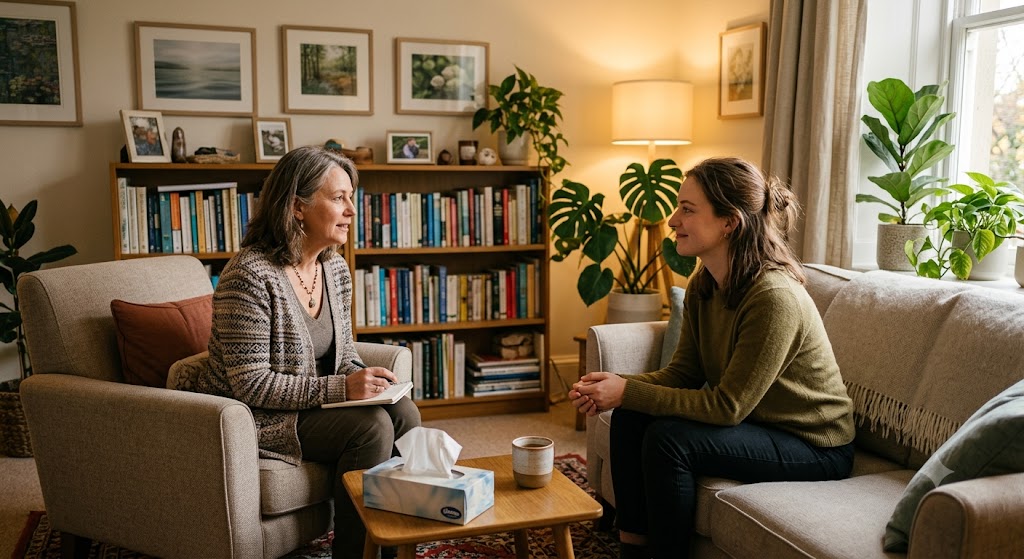
A counsellor helps clients work through genuine psychological distress: anxiety, depression, grief, trauma, relationship difficulties, low self-esteem. The job isn’t to advise or direct. It’s to hold a space in which clients can hear themselves more clearly, understand their own patterns, and find their own path through.
Counsellors work across a wide range of settings in the UK: the NHS, schools and universities, charities, GP surgeries, hospices, employee assistance programmes, and private practice. The NHS has been growing its counselling workforce, and the government has plans to expand it further over the coming decade, so for anyone thinking about employment rather than self-employment, the pathway is clear and reasonably well-signposted.
The day-to-day is emotionally demanding. Sessions can be heavy, particularly when clients bring their most difficult material. It requires genuine self-awareness, regular supervision, and strong professional boundaries. For people who are drawn to that kind of depth, though, there aren’t many careers that compare.
The Life Coaching Path
A life coach works with clients who are broadly psychologically well but feel they’re not where they want to be. Common territory includes career transitions, work-life balance, confidence, leadership development, and finding a clearer sense of direction. As a career changer, that last one might ring a bell.
Sessions are active and forward moving. You ask sharp questions, challenge clients when they’re getting in their own way, and hold them to the commitments they’ve made. Progress is usually visible within a few sessions, which is part of what makes coaching feel rewarding.
The business case is worth knowing. The corporate coaching market is sizeable, executive coaching pays well, and organisations increasingly pay for coaching as part of their people development. For someone with a background in management, HR, or leadership, that’s a route that tends to work.
Most coaches work online and one-to-one, many from their own private practice. The freedom is real. So is the task of building and sustaining a client base entirely from scratch.
Where the Paths Diverge
Becoming a Counsellor

Counselling is a serious time commitment. The BACP (British Association for Counselling and Psychotherapy) recommends a three-stage route that typically takes three to four years.
The first stage is a Level 2 Award: an introductory course, usually eight to twelve weeks at a local college. This is worth doing before anything else. It’s inexpensive, gives you a real feel for the work, and makes the commitment to a diploma far less of a leap.
The second stage is a Level 3 Certificate, covering counselling theory, ethics, and self-awareness in more depth.
The third is the Level 4 Diploma in Therapeutic Counselling, the core professional qualification, studied part-time over about two years. It includes a minimum of 100 hours of supervised client placements, academic study, personal development work, and on most programmes, your own therapy as part of the process.
Once qualified, you register with BACP, NCPS, or UKCP, and commit to ongoing supervision and CPD for the rest of your career.
For a career changer, three to four years is a meaningful commitment. Many people study part-time while still working, which is entirely manageable, but it’s not something to walk into without being sure. The training is demanding by design: the point isn’t just to learn techniques, it’s to prepare you as a person to sit with people in genuine distress. People with good parenting skills might find this easier.
Becoming a Life Coach
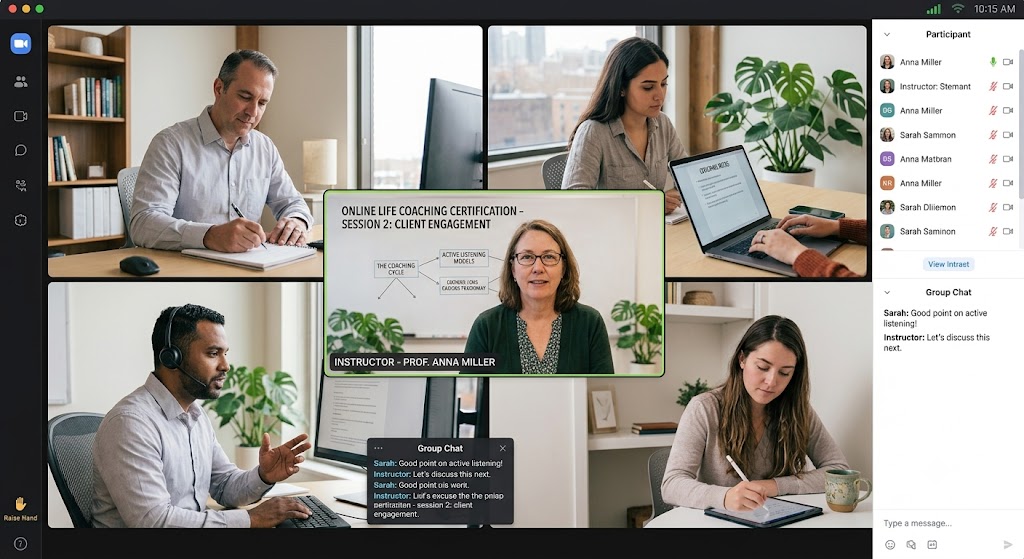
Life coaching is unregulated in the UK. No government-mandated qualification exists, no registration is required, and there’s nothing legally preventing anyone from calling themselves a coach with zero training. This is a genuine issue in the industry, and one worth being honest about when you’re sizing up the field.
In practice, the coaches who build sustainable businesses train seriously, usually with providers accredited by the ICF (International Coaching Federation), the EMCC (European Mentoring and Coaching Council), or the AC (Association for Coaching). An ICF-accredited programme can typically be completed in a few months. The ICF’s entry-level credential requires 60 hours of coach-specific training and 100 hours of coaching experience.
Compared with counselling, the investment is considerably lower and the time to practising independently is much shorter. For someone weighing up a career change without wanting to disappear from the workforce for three years, that difference is significant.
What doesn’t change is the ethical responsibility. Unregulated means the standards you hold yourself to are your own. That cuts both ways.
An Ethical Boundary
Coaching and counselling have a firm boundary between them, and responsible practitioners on both sides take it seriously.
Coaching is for people who are psychologically stable enough to pursue goals. When a coaching client starts showing signs of depression, anxiety, or trauma that belongs in a therapeutic relationship rather than a coaching one, a competent coach refers them on. The EMCC’s Global Code of Ethics states this explicitly.
Coaching isn’t a lesser version of counselling; it operates in a different space entirely. If you’re drawn to working with people who are struggling emotionally, who carry difficult histories, or who need proper therapeutic support, coaching won’t cover what they need. Counselling will.
Equally, if the slow pace of therapeutic exploration would frustrate you, if you’d rather be helping someone build something than helping them understand something, coaching is probably the better fit.
What Your Existing Career Is Worth
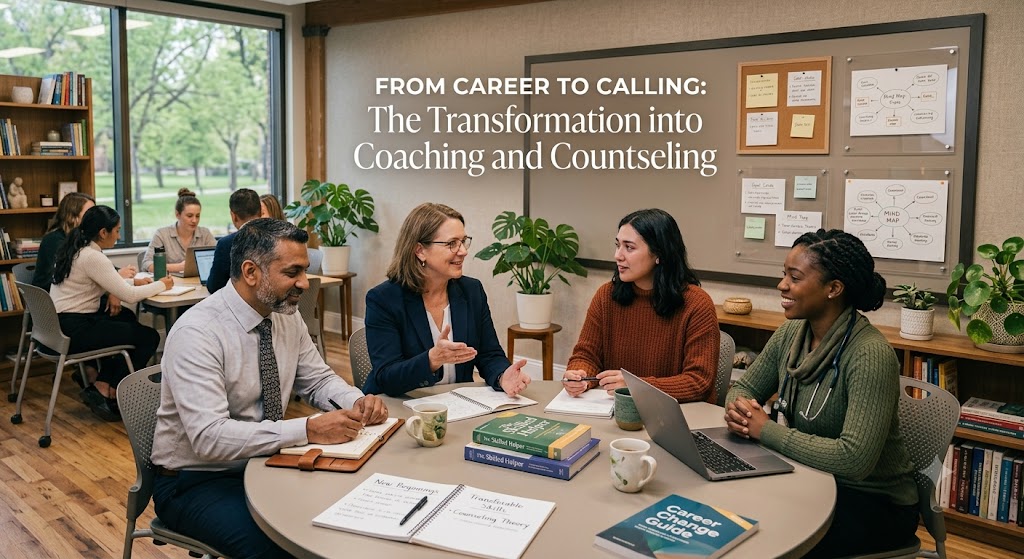
Career changers often underestimate this. Your professional background isn’t baggage you’re leaving behind. For a lot of routes into coaching in particular, it’s a genuine selling point.
Former managers and HR professionals often move naturally into executive coaching or career transition work. They bring credibility to conversations about leadership and professional development that someone without that background simply doesn’t have. Former healthcare workers, teachers, and social workers moving into coaching bring real depth of experience with people that clients and organisations notice and pay for.
In counselling, a specialist background can shape the kind of practice you build: a former teacher working with young adults, a healthcare professional focusing on chronic illness, someone from a corporate background taking on workplace stress. The experience doesn’t go to waste.
A Few Questions To Ask Yourself
How much time can you realistically spend training without it becoming financially unsustainable? Counselling takes three to four years. Coaching can have you working with paying clients within months. If money is a pressure, that gap matters.
Are you drawn more to understanding people or to getting them moving? This isn’t as simple as introvert versus extrovert. Some people find deep exploration genuinely energising; others find the slower pace of therapeutic work difficult to sustain session after session. Neither instinct is wrong, but it’s worth being honest about which describes you.
Do you want a job or a business? Counselling offers clearer employed pathways, including within the NHS. Coaching is, by default, self-employment. If the prospect of marketing yourself and managing your own client pipeline sounds more like freedom than burden, that’s a useful data point.
And practically: what would a session look like for you in ten years? If the person in front of you is talking through where they’ve come from, and you’re helping them understand it, that’s counselling. If they’re mapping out where they want to go, and you’re helping them get there, that’s coaching. It’s worth imagining both and noticing which one feels right.
Where to Go From Here
If counselling is the direction, start with bacp.co.uk. A Level 2 introductory course at a local college is the obvious first move: they’re usually affordable, often run evenings or weekends, and they let you test the work before investing in a diploma.
If coaching feels right, research ICF or EMCC-accredited training providers and look hard at what each programme actually includes, not just how quickly it can be done. Think about whether you already have a niche from your previous career, because a clear area of focus is usually what separates a coaching practice that gets traction from one that doesn’t.
If you’re still genuinely unsure, that’s a reasonable place to be. Most people who end up in either of these careers couldn’t have told you with certainty that it was right until they’d actually tried some of it. An introductory course, a conversation with someone already working in the field, a bit of honest reflection about what you actually want from work: any of those is a better next step than waiting until you’re certain.

As the Chief of Marketing at the digital marketing agency ClickDo Ltd I blog regularly about technology, education, lifestyle, business and many more topics.