

Office Clearance Checklist for UK Businesses: From Redundant IT to Furniture Disposal
Whether you’re downsizing, relocating, or simply decluttering after years of accumulation, an office clearance is one of those tasks that looks straightforward until you’re knee-deep in broken monitors, filing cabinets that no longer open, and a pile of surplus chairs that won’t fit through the stairwell.
Done without a plan, it becomes expensive, legally risky, and unnecessarily stressful. Done properly, it’s an opportunity to cut costs, meet your environmental obligations, and hand over a clean, compliant space.
This checklist covers everything UK businesses need to know before, during, and after an office clearance, from data destruction to WEEE compliance, skip hire versus managed collection, and how to avoid the most common and costly mistakes.
You may move to a more flexible workspace solution like serviced office spaces by providers such as Servcorp that offer a professional environment with all the necessary amenities while maintaining a clean and efficient workspace.
But no matter what type of office space you go for, clearance may become necessary, so read on!
Step 1: Audit Before You Clear

The biggest mistake businesses make is booking a clearance before they know what they actually have. A proper pre-clearance audit will save you money, reduce skip space, and identify items that can be sold, donated, or redeployed rather than thrown away.
For London businesses in particular, the logistics of skip placement often make a managed rubbish removal service like Rainbow Rubbish Removals the more practical and often more cost-effective choice. A single team visit, inclusive of loading, documentation, and licensed disposal, removes the coordination overhead entirely.
Your audit should cover:
- All IT hardware: desktops, laptops, servers, monitors, printers, networking equipment
- Office furniture: desks, chairs, shelving, storage units, reception furniture
- Filing and documents: paper records, archived files, confidential materials
- Kitchen and break room items: appliances, crockery, microwaves, fridges
- Stationery and supplies: anything consumable or surplus to requirements
- Fixtures and fittings: blinds, whiteboards, signage, wall-mounted equipment
Categorise each item as: resell, donate, recycle, or dispose. This not only reduces the volume going to waste but gives you a clearer brief when requesting quotes from clearance providers.
Step 2: Handle Data Destruction First
This is non-negotiable. Under the UK GDPR and the Data Protection Act 2018, businesses are legally responsible for how personal data is destroyed, and that includes data held on physical hardware. Simply deleting files or formatting a hard drive is not sufficient. Hard drives, SSDs, USB sticks, backup tapes, and even photocopier hard disks can retain recoverable data unless properly destroyed.
Your data destruction options include:
- Certified data wiping: software-based overwriting to Department for Science, Innovation and Technology (DSIT) standards (formerly NCSC-approved). Suitable for equipment being resold or donated.
- Degaussing: uses powerful magnetic fields to render data unreadable. Effective for HDDs but not SSDs.
- Physical destruction: shredding or crushing of drives. The most absolute method, and the only one suitable for highly sensitive business data.
Always request a Certificate of Destruction from your provider. This is your evidence of compliance should a data breach investigation ever arise. Never hand over hardware to a general clearance company that cannot provide this documentation.
Step 3: Know Your WEEE Obligations
The Waste Electrical and Electronic Equipment (WEEE) Regulations 2013 place specific legal obligations on UK businesses when disposing of electrical items. This covers a wide range of office equipment — computers, monitors, keyboards, phones, printers, UPS units, and even some lighting.
Businesses are defined as ‘business users’ under WEEE regulations, which means the cost of proper disposal falls to you, not the retailer or manufacturer (unless they’ve set up a take-back scheme). Fly-tipping or sending WEEE to a general landfill is a criminal offence and can result in fines up to £50,000.
Compliant WEEE disposal routes include:
- Approved Authorised Treatment Facilities (AATFs): licensed recyclers registered with the Environment Agency.
- IT asset disposal (ITAD) companies: they handle both data destruction and WEEE compliance, often with full audit trails.
- Manufacturer take-back schemes: some vendors will collect end-of-life equipment, particularly for large-volume contracts.
- Local authority WEEE collection points: practical for small volumes but not suited to a full office clearance.
When engaging any clearance provider, always confirm they hold a valid waste carrier licence issued by the Environment Agency. Ask for their licence number and verify it on the public register. This protects you from the risk of ‘duty of care’ liability — if your waste ends up illegally dumped, you can be held responsible even if you paid someone else to remove it.
Step 4: Skip Hire vs. Man-and-Van Collection — Which Is Right for You?
This is one of the most misunderstood cost decisions in office clearances. Skip hire looks cheaper on paper, but for most business clearances — particularly in urban environments — a managed collection service typically offers better value and fewer complications.
Skip hire: when it makes sense
- You have a large volume of non-specialist waste (general office waste, broken furniture, packaging).
- You have a private car park or forecourt where a skip can be placed without a permit.
- You have time to self-load and don’t need the clearance completed in a single visit.
- The waste is not mixed with WEEE, confidential documents, or hazardous materials.
Managed collection (rubbish removal service): when it makes sense
- You’re in a city centre or high street location where skip permits are required (and often refused).
- You need the clearance completed quickly, in a single day or half-day.
- You have a mixed load including furniture, IT, confidential waste, and general office rubbish.
- You want the team to do the loading and heavy lifting — most rubbish removal companies include this.
- You need a single point of accountability for waste documentation.
Step 5: Furniture — Disposal, Donation, or Resale?
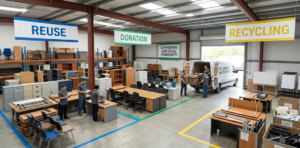
Office furniture is one of the highest-volume waste categories in any clearance and, handled right, one of the most recoverable. Before booking disposal, consider the following routes:
- Resale: platforms like Gumtree, Facebook Marketplace, and specialist commercial furniture resellers will take quality items — desks, ergonomic chairs, filing cabinets — often at short notice. Even modest recovery here offsets clearance costs.
- Donation: charities, community interest companies, schools, and social enterprises frequently need office furniture. British Heart Foundation Furniture & Electrical and similar organisations offer free collection for items in good condition.
- Manufacturer take-back: some premium office furniture brands (Herman Miller, Steelcase, Kinnarps) run refurbishment or take-back programmes as part of their sustainability commitments.
- Disposal: for items beyond reuse, ensure your clearance provider separates wood, metal, and upholstery for recycling rather than sending everything to landfill. Ask about their landfill diversion rate.
Step 6: Documents and Archives
Physical paper records are often overlooked in an office clearance but represent a significant compliance and reputational risk if not handled correctly. Under UK GDPR, personal data on paper must be securely destroyed when no longer needed for its original purpose.
Consign-and-shred services from companies like Shred-it, Restore Records Management, or a certified local provider will collect, destroy, and certify paper disposal to BS EN 15713 standard. Confidential waste bags and console services are available for smaller volumes. Never send paper containing names, addresses, financial information, or HR data to a general recycling bin.
Step 7: Book the Right Clearance Provider
Once your audit is complete and specialist streams (data, WEEE, confidential paper) are arranged, you’re ready to book a clearance provider for the remainder. Here’s what to look for:
- Valid Environment Agency waste carrier licence (check it on the public register at environment.data.gov.uk).
- Public liability insurance of at least £1 million — essential if they’re operating on your premises.
- A clear waste transfer note for every load — this is your legal duty of care documentation.
- Transparent pricing that specifies whether loading is included and how mixed loads are priced.
- Evidence of recycling and landfill diversion — responsible operators will give you a breakdown.
For businesses based in London, rubbish removal London specialists will typically be more experienced navigating permit restrictions, building management requirements, and the logistics of high-rise or basement clearances, all of which add complexity that out-of-area providers often underestimate.
The Bottom Line
An office clearance isn’t just a logistics problem — it’s a compliance exercise that touches data protection law, environmental regulation, and your organisation’s duty of care obligations. Businesses that treat it as such tend to complete clearances faster, cheaper, and with far less legal exposure than those who improvise on the day.
The checklist above gives you a repeatable framework, whether you’re clearing a single floor or an entire building. Audit first, handle specialist streams separately, choose your collection method based on actual logistics rather than headline price, and always verify your provider’s credentials before a single item leaves the premises.
Done right, an office clearance is one of the few business tasks that leaves you with less clutter, full legal compliance, and occasionally a few hundred pounds back in the bank.

Passionate content designer, contributor and content marketing allrounder at ClickDo.