

We Audited Over 1,000 UK Small Business Websites — Here’s What We Found
Opinion Piece by Simon — Founder, Get Your Website Seen
Over the past year, we’ve audited more than a thousand UK small business websites. Not a quick glance — a proper technical audit across every site, checking everything from security to search engine visibility to legal compliance.
The businesses range from builders and plumbers to accountants, photographers, taxi firms, and dog walkers. Fifty-nine different industries in total, all across the UK. The full data and methodology are published in our UK Small Business Website Health Report, which is updated weekly as we continue auditing new sites.
The picture isn’t great. In fact, some of what we found was genuinely alarming. Not because these are bad businesses — most of them are good at what they do. The problem is that their websites are letting them down in ways they probably don’t even know about.
Here’s what the data shows.
More Than Half Are Sitting on a GDPR Time Bomb
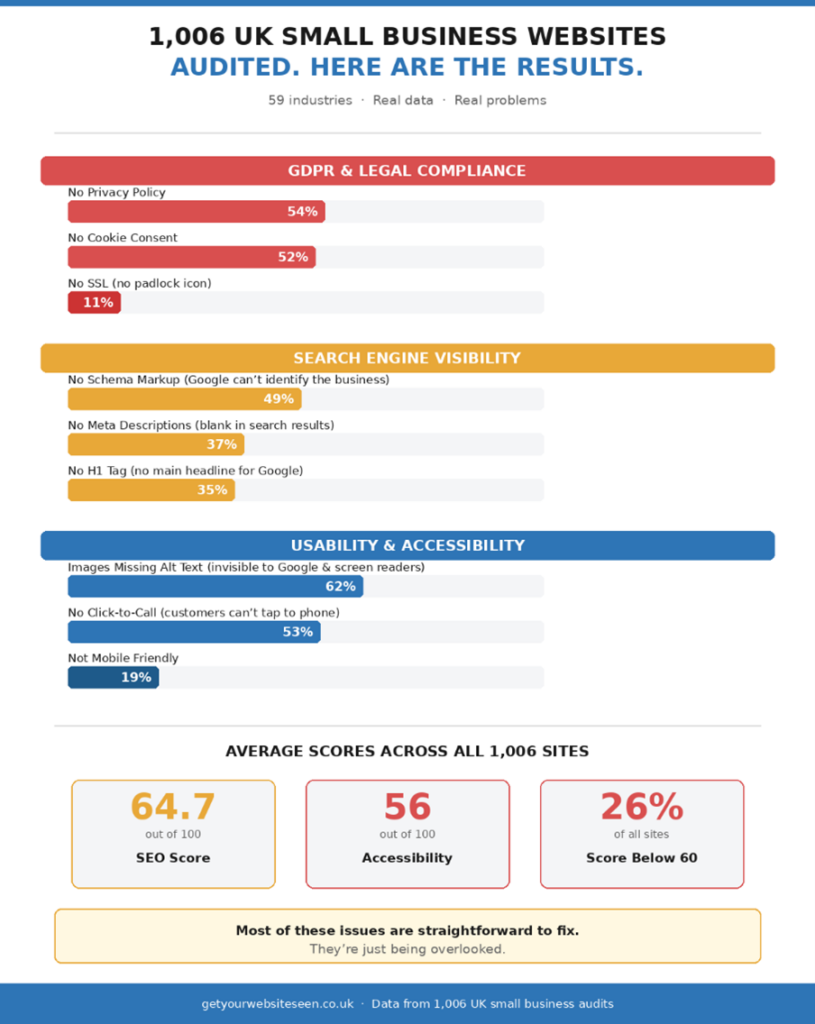
This was the one that stopped us in our tracks. Of the 1,006 sites we audited, 54% had no privacy policy. That’s the page on your website that explains what data you collect from visitors and what you do with it. Under UK data protection law — GDPR — you’re legally required to have one if your site collects any personal information at all. And if you’ve got a contact form, an email signup, or even basic analytics running, you’re collecting personal information.
It gets worse. 52% had no cookie consent mechanism — that’s the pop-up you see on most websites asking you to accept or reject cookies before the site tracks your browsing. Again, legally required in the UK. Without it, you’re technically breaking the law every time someone visits your site.
These aren’t technicalities. The ICO (Information Commissioner’s Office) — the UK body that enforces data protection — has been increasingly active in going after smaller businesses, not just the big corporates. According to the ICO’s enforcement actions, fines for cookie consent violations start at £17,500 and go up from there. More than half the businesses we looked at are exposed to this, and most of them have no idea.
Nearly Half Are Invisible to Google
If GDPR is the legal risk, this is the commercial one. Nearly half of the sites we audited — 49% — had no schema markup. Schema is a bit of code you add to your website that tells Google exactly what your business is, what you do, and where you’re based. Without it, you’re relying on Google to figure all of that out on its own. Sometimes it does. Often it doesn’t. And when it doesn’t, you don’t show up.
Think of schema like a name badge at a networking event. You could walk around at the venue and hope people work out who you are and what you do from context, or you could wear a badge that says it clearly. Schema is that badge, but for search engines.
On top of that, 37% of sites were missing meta descriptions. That’s the short summary text that appears underneath your page title in Google’s search results. It’s the first thing a potential customer reads about you. If you haven’t written one, Google will pull a random snippet from your page instead, and nine times out of ten it’ll be something unhelpful or half a sentence that makes no sense.
And 35% had no H1 tag. The H1 is the main headline on your page — the big bit of text at the top that tells both visitors and Google what the page is about. Without it, Google must guess. And Google’s guesses aren’t always kind.
The Basics Are Being Missed
Some of what we found was baffling. These are local businesses — they rely on customers in their area picking up the phone or sending an enquiry. And yet 53% of the sites we looked at didn’t have a click-to-call button. That’s a phone number on your website that someone can tap on their mobile and it dials you straight away. More than half of all UK internet use is on mobile. If someone finds your business on their phone and must manually copy your number, switch to their dialler, and paste it in, a good chunk of them simply won’t bother. They’ll call the next business on the list instead — the one where they could tap and call.
Then there’s alt text. 62% of sites had images with no alt text — that’s the description attached to an image that tells Google what the picture shows and allows screen readers to describe images to people who are visually impaired. Without it, Google treats your images as blank space. You’re missing out on image search traffic entirely, and you’re making your site inaccessible to a significant portion of the population. According to the UK Government’s Family Resources Survey, around one in five people in the UK has a disability — that’s a significant number of potential customers being excluded.
Speaking of accessibility — the average accessibility score across all 1,006 sites was just 56 out of 100. That measures how easy your website is to use for people with disabilities, including things like colour contrast, keyboard navigation, and screen reader compatibility. Beyond the moral argument, there’s a practical one: accessible websites tend to rank better in Google because they’re better structured and easier to navigate for everyone.
And 11% of sites still didn’t have SSL. That’s the padlock icon you see in your browser bar when a website is secure. Without it, visitors get a “Not Secure” warning from their browser before they even see your site. Google has also confirmed that SSL is a ranking factor. In 2026, there is no good reason not to have it — most hosting providers offer it for free.
What This Actually Means for Your Business

Numbers on a page are one thing. What matters is what they mean in practice.
If you’re a plumber in Leicester with no schema markup, no meta description, and no click-to-call, here’s what’s happening: someone in your area searches “plumber near me,” Google isn’t sure what your site is about, so it ranks your competitor instead. Even if you do show up, the search result has a generic snippet because you haven’t written a meta description, so the customer clicks on the competitor who has a clear, professional-looking listing. And even if the customer does land on your site on their phone, they can’t easily call you — so they go back and call someone else.
Every one of these issues is a leak in the bucket. Individually they’re small. Together, they’re the difference between a website that generates business and one that just sits there looking nice.
And the GDPR issues? That’s not a slow leak, that’s a potential flood. One customer complaint to the ICO about how you handle their data, and you’re looking at an investigation and a minimum fine that would wipe out a good few months’ profit for most small businesses.
The Good News
Here’s the thing that surprised us most: the vast majority of these issues are straightforward to fix. Adding a privacy policy and cookie consent takes an afternoon. Schema markup, meta descriptions, H1 tags, alt text, click-to-call buttons — none of this is expensive or complicated. It’s just being overlooked.
Most small business owners built their website years ago, or paid someone to build it, and haven’t thought much about it since. That’s understandable — you’re busy running a business. But these aren’t cosmetic issues. They’re the difference between being found and being invisible, between being compliant and being exposed.
The average SEO score across the sites we audited was 64.7 out of 100. That’s a C grade at best. Over a quarter scored below 60. These are real businesses with real customers, and their websites are actively holding them back.
Where to Start

If any of this has made you wonder about your own website, the simplest thing you can do is get it audited. Not a sales pitch disguised as an audit — a proper look at what’s working, what’s not, and what needs fixing. You can see the full breakdown of our findings, including methodology and industry-by-industry data, in our UK Small Business Website Health Report. And if you want to know what Google really thinks of your website, get in touch — we’ll happily run a free audit and show you where you stand.
About the Author
Simon is the founder of Get Your Website Seen (GYWS), a UK SEO and digital marketing agency that works exclusively with small businesses across Britain. With a background that includes building and selling three businesses — one of which achieved the number one Google ranking worldwide — Simon brings hands-on experience and a no-nonsense approach to helping businesses get found online. He runs GYWS alongside his wife Lisa, and their focus is simple: real results for real businesses, with none of the industry waffle.
