
Why We Built Our Own SEO Tools — And Why Off-the-Shelf Doesn’t Work for Small Businesses
Opinion Piece by Simon — Founder, Get Your Website Seen
There’s a running joke in our house that I’d rather spend a weekend building a tool than spend ten minutes using someone else’s. Lisa will tell you it’s not entirely a joke. But there’s a reason we ended up building our own SEO auditor, our own CRM, and our own outreach system from scratch — and it wasn’t because we wanted a project.
It was because nothing out there did what we needed it to do. And what we needed it to do was actually quite simple: help UK small businesses get found online, without all the noise.
The Problem with Enterprise Tools
If you’ve ever looked into SEO tools, you’ll know the big names. Semrush, Ahrefs, Moz — they’re powerful platforms, and if you’re a marketing team at a large corporation managing campaigns across multiple countries and dozens of websites, they’re brilliant. They’ve got dashboards for everything, hundreds of metrics, competitor analysis tools that go fifteen layers deep, and pricing to match.
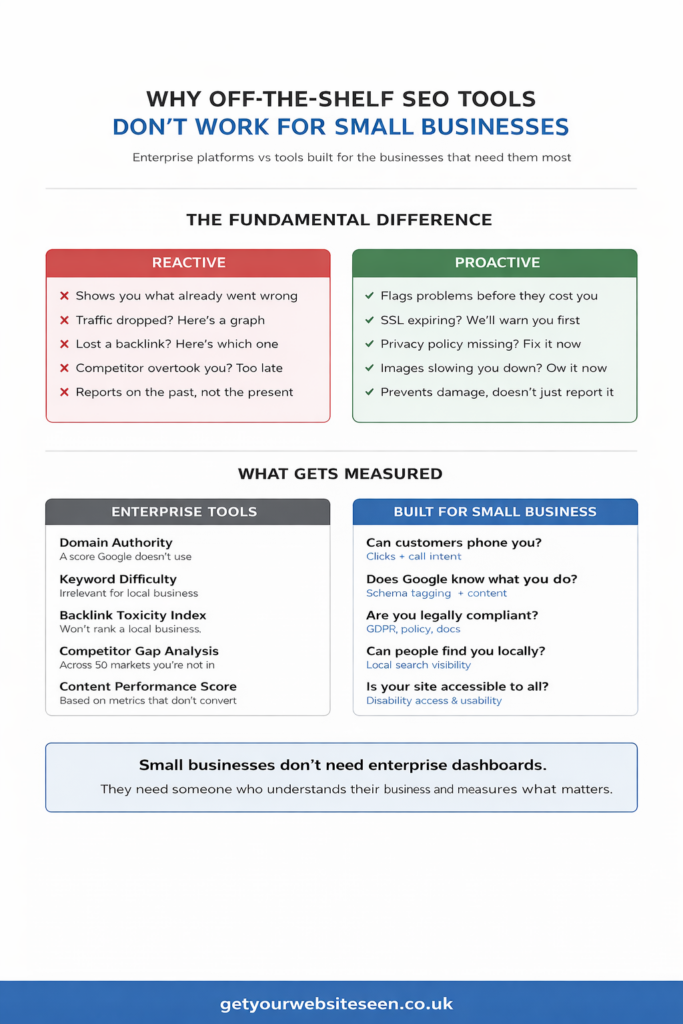
But here’s the thing. A builder in Hampshire doesn’t need any of that. A cleaning company in the Midlands doesn’t need to track keyword difficulty scores across fifty markets. A photographer in Leicestershire doesn’t need a backlink toxicity analysis with a domain authority comparison matrix. They need to know: can people find me on Google? Are the basics on my website right? What’s stopping me from getting more enquiries?
The big tools weren’t built for that conversation. They were built for enterprise marketing departments with enterprise budgets. And when you try to use them for a small local business, you end up drowning in data that doesn’t matter and missing the stuff that does.
Reactive vs Proactive
This is the bit that really made us want to build our own. Most SEO tools are reactive. They show you what’s already happened. Your traffic went down last month — here’s a graph. You lost a backlink — here’s which one. A competitor overtook you — here’s the data. All useful in theory, but by the time you’re reading that report, the damage is already done.
What a small business needs is the opposite. They need to know what’s wrong right now and what to fix first. Not a retrospective — a checklist. Is your SSL certificate about to expire? We’ll flag it before it does, not after your visitors start seeing “Not Secure” warnings. Is your privacy policy missing? We’ll tell you today, not after the ICO comes knocking. Are your images slowing your site down? Let’s deal with it now, before it costs you another month of lost visitors.
That’s what proactive looks like. And none of the off-the-shelf tools were set up to do it — at least not for the kind of businesses we work with.
Built for the Businesses We Actually Work With

So, we built our own. Our auditor doesn’t try to do everything — it does the things that matter for UK small businesses, and it does them properly. When we audit a site, we check security, legal compliance, search engine visibility, mobile usability, accessibility, page speed, and the technical fundamentals that actually affect whether Google shows you to your local customers.
The results come back in plain English. Not a 47-page PDF full of graphs and jargon that ends up in a drawer. A clear, prioritised summary of what’s working, what’s not, and what to fix first. Because if you tell a small business owner that their “core web vitals are suboptimal and their cumulative layout shift exceeds the recommended threshold,” they’re going to nod politely and do nothing. If you tell them their website takes too long to load and it’s costing them customers, they’ll fix it tomorrow.
We built our CRM the same way. Most CRM platforms are designed for sales teams with pipelines and deal stages and automated workflows that would make your head spin. We needed something simpler: a way to track who we’ve spoken to, what we found on their site, what we’ve done for them, and what needs doing next. So that’s what we built. It talks directly to our auditor, so when we run an audit the results feed straight into the client’s record. No copy-pasting, no spreadsheets, no messing about.
And our outreach system? Same principle. We wanted to contact local businesses about genuine issues we’d found on their websites — not spam them with generic sales emails. So, we built a system that takes real audit data and turns it into honest, personalised outreach. “We looked at your website, here’s what we found, here’s what it means, we’re here if you want help.” Not “Buy our SEO package.” The difference matters.
What We Look for that Others Don’t
When you understand small businesses — and I mean properly understand them, not just sell to them — you start measuring different things. The big platforms will tell you your domain authority and your keyword gap analysis. Useful if you know what to do with it. Meaningless if you don’t.
We look at whether your phone number is tappable on a mobile. We check if you’ve got a Google Business Profile and whether it matches what’s on your website. We look at whether Google actually understands what your business does and where it operates. We check your GDPR compliance because a £17,500 fine will hurt a small business a lot more than it’ll hurt a corporation. We look at accessibility, because one in five people in the UK has a disability and if your site doesn’t work for them, that’s customers you’re turning away.
These aren’t the metrics that make the front page of a fancy dashboard. But they’re the ones that make the difference between a website that generates business and one that just takes up space on the internet.
The AI Question
Everyone’s talking about AI in SEO at the moment. AI-generated content, AI audits, AI strategies. And some of it is useful — we’d be daft to pretend otherwise. But there’s a difference between using AI as a tool and using it as a replacement for actually knowing what you’re doing.
An AI tool can crawl your website and generate a list of technical issues. What it can’t do is understand that you’re a two-person cleaning company that covers Coventry and Warwickshire, that your main competitors are three specific firms, that your best customers come from end-of-tenancy cleans, and that your website needs to reflect all of that if it’s going to rank for the searches that bring in paying work.
That understanding comes from experience. From having built and sold businesses ourselves. From having spoken to hundreds of small business owners about what they actually need, not what a tool thinks they need. The technology is there to support that understanding, not replace it.
Small Businesses Deserve Better Tools
The SEO industry has spent years building tools for the biggest clients with the biggest budgets. That’s fine for them. But the small businesses that make up the backbone of the UK economy have been left with two choices: pay for enterprise tools they don’t need and can’t fully use or go without and hope for the best.
We decided there should be a third option. Tools that are built specifically for small businesses, that focus on the metrics that actually matter, that flag problems before they become expensive, and that present everything in language a normal person can understand.
That’s what we’ve built at Get Your Website Seen. Not because we wanted to reinvent the wheel, but because the existing wheels didn’t fit. If you want to see what that looks like in practice, have a look at some of our client case studies — real businesses, real results, no smoke and mirrors.
About the Author
Simon is the founder of Get Your Website Seen (GYWS), a UK SEO and digital marketing agency that works exclusively with small businesses across Britain. With a background that includes building and selling three businesses — one of which achieved the number one Google ranking worldwide — Simon brings hands-on experience and a no-nonsense approach to helping businesses get found online. He runs GYWS alongside his wife Lisa, and their focus is simple: real results for real businesses, with none of the industry waffle.
