
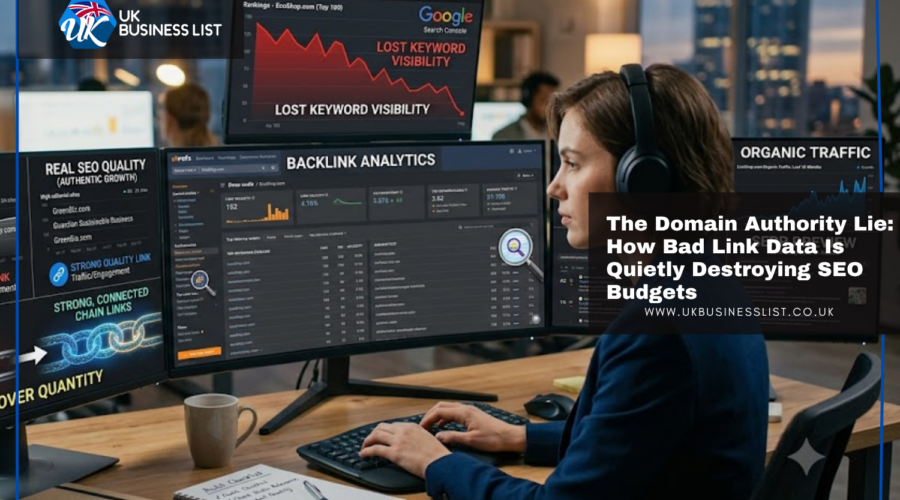
The Domain Authority Lie: How Bad Link Data Is Quietly Destroying SEO Budgets
Marcus Chen spent eleven months and roughly $14,000 building what his agency promised was a “premium backlink portfolio.” Every report showed green numbers. Domain Authority scores looked impressive on paper.
Then Google’s March 2024 core update hit. His e-commerce site dropped from page one to page four almost overnight. When he finally dug into his link profile, he found it stuffed with high-DA sites that hadn’t seen real human traffic in years.
Some were obviously link farms dressed up with cosmetic metrics. Others were outright PBN properties sold as “genuine outreach.” Marcus isn’t an outlier. He’s the predictable outcome of an industry built on a single, deeply flawed number.
There’s more to SEO than Domain Authority (DA)
Scaling link acquisition through a dedicated guest post outreach service that actually vets donor sites on multiple dimensions could have saved him every dollar and every ranking position he lost.
This is the story of how Domain Authority became SEO’s most dangerous comfort blanket. And why the professionals who keep trusting it are making their clients pay the price.
How DA Became SEO’s Most Abused Metric

Domain Authority was never designed to be the thing it became. Moz created it as an internal modeling tool. A rough approximation. A conversational shorthand for comparing link profiles at a glance. It was not built to be the primary purchase criterion for an entire industry’s link acquisition decisions.
But that’s exactly what happened.
By the mid-2010s, guest post marketplaces were openly listing placements by DA tier. DA30 costs this much. DA50 costs that much. The number became a price tag. And once money attached itself to a metric, manipulation followed almost immediately.
Today you can buy DA inflation services for a few hundred dollars. Private blog networks game the metric deliberately. Expired domain squatters rebuild sites specifically to hit a DA threshold and then sell placements to unsuspecting buyers. The metric that was supposed to signal quality became the signal that bad actors game most aggressively.
Research published through academic SEO analysis has consistently shown that high-DA sites can produce zero organic traffic, minimal topical relevance, and links that Google essentially ignores at the ranking algorithm level. Yet the industry keeps quoting DA like its gospel.
The people hurt worst by this are not massive enterprises with in-house SEO teams who can audit every link. They’re small business owners, solo consultants, and lean agency teams who trusted that a high number meant a good link. They paid. They waited. Their rankings didn’t move. And nobody at the vendor end issued a refund because technically they delivered what they promised: a link on a high-DA site.
What Passes as “Vetting” in the Commodity Link Market
Here’s the uncomfortable truth about most blogger outreach services operating today. Their vetting process is a DA check and maybe a quick spam score glance. That’s it. Two data points. For a decision that can meaningfully affect a client’s Google standing for months or years.
Think about what that actually misses:
It misses traffic trends. A site can have a DA of 45 and receive fewer than 200 organic visitors per month because its rankings collapsed two years ago and it never recovered. The DA score didn’t update to reflect reality because DA doesn’t track that in real time.
It misses outbound link patterns. Some sites with respectable DA numbers are also linking to gambling affiliates, payday loan schemes, and adult content directories. Those outbound associations affect how Google reads every link on that page, including yours.
It misses editorial independence. A site run by a PBN operator who accepts any content for the right price is not an editorial placement. It’s a purchased spot in a link farm that happens to have a passable DA score. Google’s spam policies, updated with increasing aggression since the 2023 and 2024 helpful content rollouts, explicitly target exactly this arrangement.
It misses audience engagement. A blog with authentic topical authority has readers who come back, who leave comments, who share content. Those behavioral signals reinforce the page’s authority in ways DA cannot capture. A zombie site with great metrics but no real audience passes zero of that authority downstream.
None of this gets caught by a two-point checklist. And the agencies that operate on two-point checklists are not going to volunteer that information to their clients.
The Hidden Damage: What Bad Links Actually Cost

Penalties get the headlines. Manual actions, algorithmic drops, sudden traffic collapses. Those are real and they happen. But they’re actually not the most common outcome of bad link building.
The more common outcome is quieter and arguably worse. You spend money. Links go live. Nothing happens. Rankings don’t move. Traffic stays flat. Your link profile absorbs dozens of placements that contributed no equity whatsoever, and you spend the next six months wondering whether your content is the problem, your on-page SEO is the problem, or your technical setup is the problem.
You invest in audits. You revise strategy. You test variables.
Meanwhile the real problem, a link profile full of traffic-dead, topically irrelevant, editorially compromised placements, just sits there doing nothing.
A 2023 analysis by SEO researchers tracking correlation between link quality signals and ranking outcomes found that links from sites with genuine organic traffic were significantly more likely to produce measurable ranking improvements than links from sites matched on DA alone. The traffic signal, not the authority score, was the stronger predictor.
That finding should have reshaped how the industry prices and sells guest post placements. It mostly didn’t. High DA is still the headline metric across the majority of link vendor dashboards because it’s easy to advertise, easy to understand, and easy to manufacture.
What Rigorous Vetting Actually Looks Like

Multi-factor donor site evaluation isn’t a novel concept. It’s just inconvenient to execute at scale, which is why most vendors skip it.
A real screening process looks at organic traffic trends over time, not just current snapshot numbers. It examines niche topical alignment, asking whether the site actually covers the subject area your link will appear in or whether it’s a generalist dumping ground that accepts content on any topic that pays.
It checks editorial history: how long has the site been publishing original content? Is there a consistent human author or editorial identity behind it? Or did it suddenly start accepting guest posts after acquiring an expired domain with inherited link equity?
It also checks the outbound link neighborhood. Where else is this site linking? If significant portions of its outbound links go to grey-market niches, that context stains every placement on the site regardless of your content quality.
And it checks audience engagement signals: comments, social shares, return visitor patterns, time on page metrics. A site with authentic reader engagement is a site where your placement will be seen by real people, which matters both for direct referral traffic and for the behavioral signals Google reads when evaluating page authority.
This kind of vetting requires human judgment. You can’t automate topical alignment assessment or editorial authenticity evaluation. Crawlers don’t read editorial voice. Algorithms don’t catch PBN footprint signals that a trained human reviewer would spot in five minutes of investigation.
An 18-point quality control checklist applied manually to every potential donor site is not an extraordinary standard. It’s just what the bar should look like if you’re serious about protecting clients from the category of damage outlined above. Most services don’t come close to it because it requires time, expertise, and a willingness to reject sites that would otherwise generate revenue.
Content Quality: The Placement Factor Everyone Pretends Doesn’t Matter

Even a perfectly vetted donor site can’t save a bad guest post.
Google’s Helpful Content system doesn’t evaluate links in isolation. It evaluates the page the link sits on. A placement surrounded by thin, generic, AI-generated filler content sends a different signal than a placement embedded in an original, expert-level piece that genuinely serves the donor site’s audience.
The post-2023 landscape made this dramatically more consequential. Google’s spam policies now explicitly include “scaled content abuse,” which covers mass-produced guest posts regardless of whether they were written by humans or generated by AI. The question Google is asking is whether the content serves the reader or whether it exists primarily to host a link. Thin, generic submissions fail that test no matter what domain authority the host site carries.
This is why content written by actual subject-matter experts, people who understand the niche, use accurate terminology, and make original arguments that resonate with the host site’s actual audience, produces fundamentally different link equity than content churned out to meet volume targets. The engagement signals on the hosting page, time spent reading, scroll depth, return visits, tell Google whether the content is serving readers. Those signals feed back into how much authority that page passes downstream.
Native-level writing isn’t a quality luxury. In 2025, it’s a compliance requirement for placements that want to survive the next algorithm update cycle.
The Agency Problem: Why Your Clients Are Absorbing the Risk You’re Not Disclosing
SEO agencies occupy a specific and uncomfortable position in this ecosystem. They’re the intermediary layer between clients who trust them and link vendors who are often selling metric theater. When a placement underperforms or contributes to a penalty, the agency absorbs the client relationship damage. The vendor walks away untouched.
The standard vendor model makes this worse. Pay upfront. Accept what’s delivered. If the placement is on a traffic-dead site with a suspiciously inflated DR score and content that reads like it was written in forty-five minutes, that’s what you bought. Your money is gone. The link is live. The vendor’s obligation is discharged.
This arrangement has zero accountability built into it. The vendor has no financial incentive to deliver quality because they’ve already been paid. The agency, having trusted the vendor’s DA numbers and glossy service page, has no visibility into what was actually delivered until they dig into the client’s link profile themselves.
A satisfaction-first payment model changes this dynamic entirely. When a vendor doesn’t get paid until the client is fully satisfied with the placement, topical relevance, content quality, and donor site metrics, the financial incentive flips. Quality stops being optional and becomes economically necessary. A service confident enough to operate on that model is making a public statement about how it expects its own deliverables to perform.
Similarly, a six-month warranty on placements changes the post-delivery accountability calculus. If a link disappears, loses its do follow status, or the hosting page gets deindexed, a warranted placement gets replaced or refunded. That commitment filters out vendors who know their placements are fragile. A vendor who won’t back their placements for six months almost certainly knows those placements won’t hold up for six months.
What the Real Process Should Look Like: A Standard for Comparison
Evaluating any white hat link building service honestly requires looking at its operational process, not just its marketing copy.
Here’s the sequence that separates legitimate manual outreach from commoditized DA reselling:
Stage one is prospect sourcing. Donor sites should be identified through niche-specific editorial research, not pulled from pre-compiled link databases that every competing vendor is also using. The test is simple: does the vendor have direct relationships with independent blog owners in your niche, or are they working through an intermediary marketplace?
Stage two is editorial negotiation. A real outreach process involves pitching the blog owner a topic, agreeing on angle and content standards, and confirming anchor text placement parameters before writing begins. This stage doesn’t exist in automated outreach systems, which is why automated systems produce lower placement acceptance rates and lower editorial quality.
Stage three is content production. Subject-matter expert writing, not templated production, not AI-generated drafts run through a light editing pass. The test here is whether the content would be accepted and published if there were no backlink attached to it.
Stage four is pre-publication review. Clients should be able to see both the proposed donor site and the article draft before publication. No surprises. No “we already published it” notifications after the fact.
Stage five is post-placement verification. Do follow status confirmed. Indexation verified. Anchor text accurate. Placement documentation delivered. This step is how you know the vendor is confident their work will hold up to scrutiny.
Services that skip stages two, four, or five are not doing manual blogger outreach. They’re doing bulk placement with manual branding. The distinction matters enormously for your link profile’s long-term health.
Accessible Pricing and the Agency Scalability Question
One objection that consistently holds back mid-market agencies from shifting to quality-first outreach is the assumption that rigorous vetting means enterprise-level pricing. It doesn’t have to.
Starter-tier placements with DR/DA 20+ and verified organic traffic are accessible entry points that work for solo consultants building niche authority, small brands establishing initial link equity, and agencies testing a new vendor before committing to volume. Professional-grade placements with DR/DA 40+ and 5,000+ monthly visitors represent the mid-market sweet spot where most agency campaigns operate.
For agencies specifically, the operational calculus changes when vendor quality is consistent. In-house prospecting, outreach, follow-up, and placement tracking across multiple client verticals is a significant time cost. When a dedicated manual link building service handles that entire pipeline and guarantees deliverable quality, the margin argument for delegation becomes straightforward.
Niche compatibility across virtually every vertical matters here too. An agency managing clients across fintech, health and wellness, SaaS, and e-commerce needs a vendor with pre-vetted editorial contacts in each of those spaces. Starting that prospecting effort from scratch for each new client niche is where in-house outreach programs consistently break down.
The Accountability Gap Won’t Close Itself
The DA-first link market persists because it’s profitable for vendors and because buyers haven’t demanded better. Every budget wasted on metric theater is budget that could have built genuine topical authority and produced rankings that actually hold.
The tools for doing this right exist. The methodology is established. Multi-factor vetting, manual editorial relationships, expert content and citations, and financial accountability structures are not experimental approaches. They’re just less convenient to sell in a race-to-the-bottom pricing environment.
What changes the outcome is demanding process transparency before signing off on any link budget. Ask the vendor what their vetting checklist covers. Ask how many factors they’re scoring beyond DA. Ask whether they get paid before or after you approve the placement. Ask what happens if the link disappears in four months.
The vendors who can answer those questions clearly and specifically are the ones worth trusting with your clients’ link profiles. The ones who deflect back to DA numbers are telling you exactly what their process is worth.
Marcus Chen rebuilt his link profile over the following year. He did it slowly, with far fewer placements, but with rigorous vetting on every single donor site. His rankings recovered. His agency kept the client. The lesson cost him fourteen thousand dollars and nearly a year of stalled growth. It didn’t have to.
Author bio:
Ahtasham is an Advertising Partnerships Manager at Futuristic Artists, a digital marketing agency specialising in SEO, content strategy, and link building for businesses across multiple industries. With years of hands-on experience managing large-scale link building campaigns, Jimmy has developed a sharp understanding of how flawed domain authority metrics can mislead SEO investment decisions. He is passionate about bringing transparency and data integrity to the world of digital marketing.

Covering unique UK business stories, business advice and news to keep the UK Business List audience informed!