
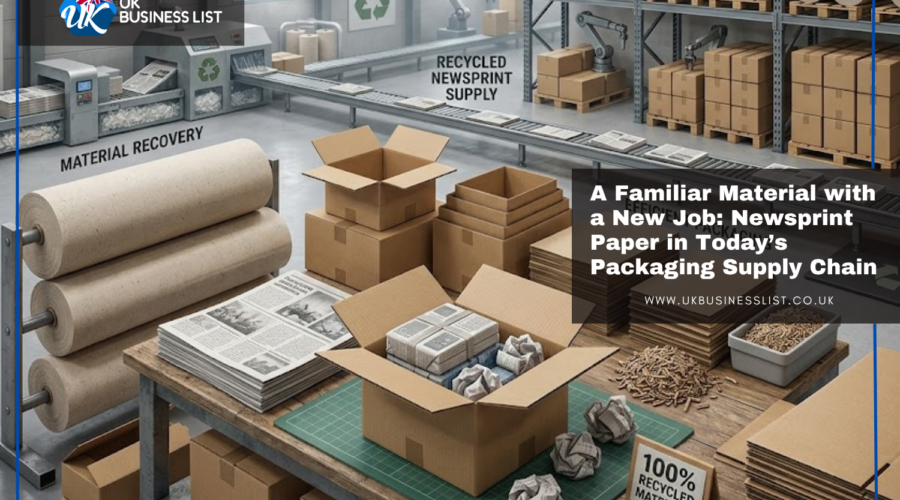
A Familiar Material with a New Job: Newsprint Paper in Today’s Packaging Supply Chain
Packaging does not always need to be elaborate. For many businesses, particularly those packing and shipping products in volume, some of the most useful materials perform relatively simple jobs: filling empty space, separating items, protecting surfaces or wrapping goods before packing them in a cardboard box.
Newsprint paper is one such material. Best known for its traditional role in newspapers and magazines, this lightweight paper grade is also used in logistics, warehousing and e-commerce packaging. Supplied in rolls or sheets, it can be used for protective wrapping and cushioning, carton filling, separating packaged items and protecting goods in storage.
Its continued use illustrates a broader point for SMEs reviewing their packaging: finding an appropriate material does not necessarily mean finding the newest or most complex one. What matters is how well its properties match the task—and what happens to the material throughout its wider production and supply chain.
Packaging Efficiency Starts Before the Packing Bench
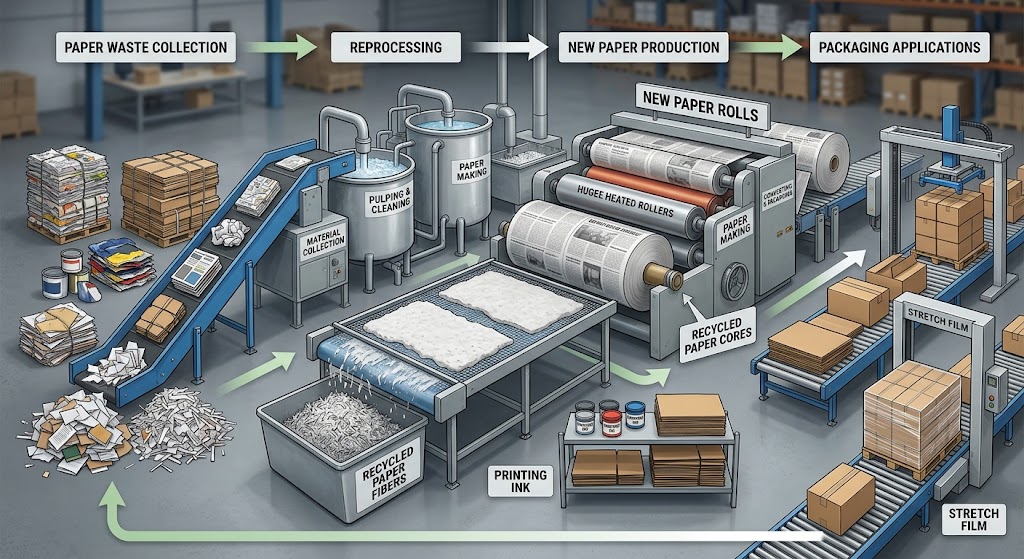
That wider picture begins well before a roll or sheet reaches a warehouse. The way offcuts, surplus stock and other production materials are handled can influence how efficiently resources are used during paper manufacturing.
Paper and board offcuts, for example, can be returned to paper mills and reprocessed into new paper. Some of this material may later return to production in another form, such as the cores used for rolls of paper. Surplus sheets and rolls can also be directed to secondary packaging applications rather than immediately being sent for pulping, giving material that has already been manufactured another practical use.
The same principle extends beyond paper. Metal barrels used for ink deliveries may be repurposed by other industries, while plastic stretch film from pallets can be recycled into new synthetic raw material. Leftover printing inks can also be recovered and reused as black pigment in kraft paper production.
These are specific examples of material recovery rather than broad claims about the environmental performance of paper packaging. Formal management systems can provide a structure for overseeing and monitoring such processes. ISO 9001 covers areas including process control, documentation, corrective actions and continuous improvement, while ISO 14001 requires organisations to identify and monitor environmental aspects, assess compliance obligations and work systematically to improve ecological performance.
The result is a more complete way of looking at packaging efficiency: not only at how much material is placed inside a parcel, but also at how materials are handled before the finished packaging reaches the user.
Why Newsprint Paper Works as Protective Paper
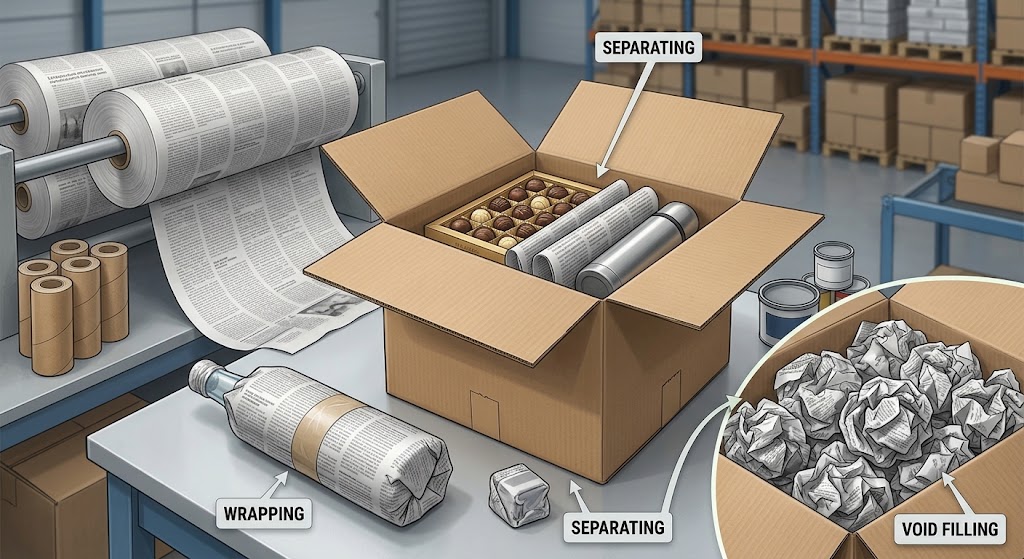
Once newsprint paper reaches the packing stage, its physical properties determine where it can be useful. It is a lightweight, uncoated paper grade typically manufactured from recycled fibres or mechanical wood pulp. This makes it easy to fold, wrap and crumple, while its surface strength allows it to perform a range of dry protective functions.
Newsprint used for packaging generally ranges from 42 to 90 g/m², depending on the fibre supply and production batch. Carccu®, a Finnish paper packaging manufacturer and printing house, most commonly supplies a 45 g/m² grade. This provides a balance of flexibility and surface strength for applications including wrapping, separating items inside a package and filling boxes. Newsprint, sometimes referred to in Scandinavia as mackle, may include reclaimed newspaper and magazine paper as well as printer rejects, waste sheets or spoiled sheets. The way the material is used follows naturally from these characteristics. Sheets can be placed between products to help protect their surfaces, wrapped around individual goods or crumpled to fill gaps inside a cardboard box and reduce movement during transport. Newsprint can also provide temporary surface protection during storage.
Its limitations are equally important when deciding where it belongs. Newsprint is not moisture resistant and is not intended for heavy loads or applications involving substantial exposure to grease. Its role is therefore a defined one: lightweight protection in dry packaging and storage environments.
When the Protective Layer Also Carries Information
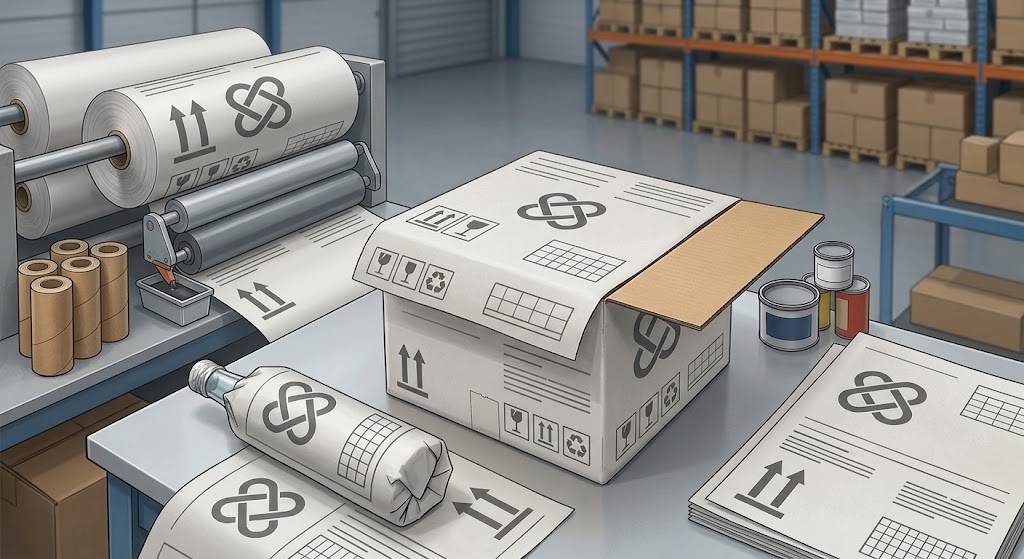
That practical role can be extended through printing. Instead of using newsprint solely as an anonymous protective layer, businesses can add logos, batch markings or handling instructions directly onto the paper.
Flexographic printing is commonly used for this purpose, particularly in larger production runs. The technique works well on uncoated paper and allows information to be printed directly onto newsprint without introducing a separate material layer.
The surface itself sets some parameters for design. Because newsprint is uncoated and slightly absorbent, clear, high-contrast graphics generally work better than intricate images requiring very fine reproduction. In protective packaging this may be entirely appropriate. An easily recognised logo or clearly legible handling instruction can be more useful than the detailed graphics associated with consumer-facing retail packaging.
Newsprint paper can be printed on when this suits the intended application. Printing can therefore give the protective paper an additional communication function without changing the basic material or its purpose inside the package.
Following the Paper Trail Back to Its Source
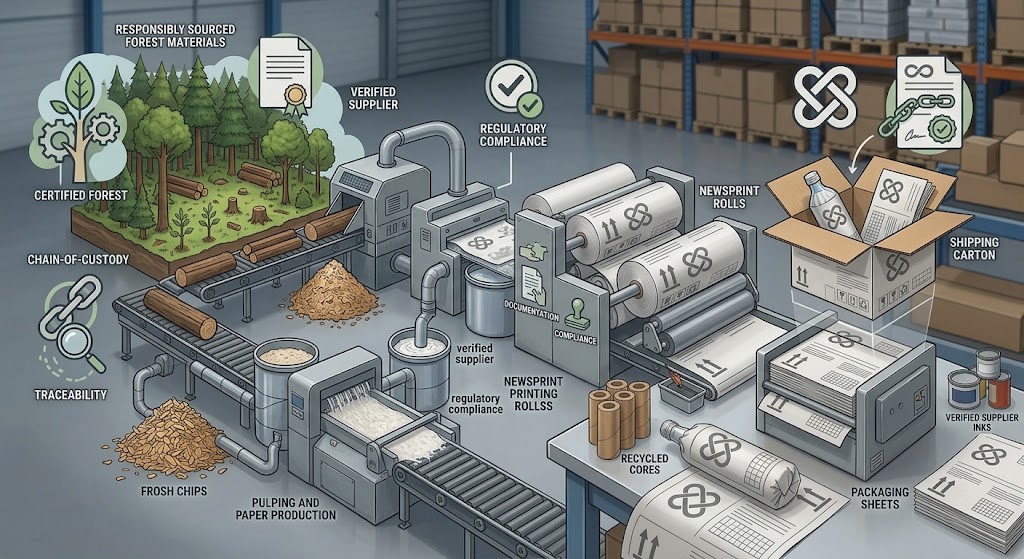
How newsprint paper performs and what can be printed on it are visible characteristics. Less visible, but increasingly important within packaging supply chains, is the documentation behind the forest-based raw materials themselves.
FSC® Chain of Custody certification establishes requirements for tracking certified wood-based materials through the supply chain. Certified materials must be identified and managed according to defined procedures as they move through production, with compliance verified through independent accredited audits.
PEFC Chain of Custody certification provides another framework for tracing certified forest-based materials through supply chains. For packaging buyers, these systems provide documented information about certified fibre sourcing rather than requiring them to rely on broad environmental statements.
Regulatory requirements add a further dimension to this traceability. Under the EU Deforestation Regulation (EUDR), companies placing certain forest-based products on the EU market must conduct due diligence and demonstrate compliance with requirements relating to legal sourcing, deforestation and forest degradation. This includes measures such as supplier verification, traceability documentation and risk assessment.
A material as straightforward as newsprint paper can therefore sit within a considerably more detailed system of certification, sourcing-records and regulatory documentation. For businesses purchasing paper packaging, its physical specifications are only one part of the information available for assessing the material.
Matching the Material to the Job
Taken together, these characteristics point towards a fit-for-purpose approach to packaging. Newsprint paper does not offer the moisture resistance required for wet conditions, nor is it intended to provide heavy-duty protection. There are other materials for those tasks.
Its usefulness lies instead in applications that make use of the properties it already has. A dry product may require a lightweight separating layer. A carton may need flexible material to fill gaps around its contents. Goods in storage may benefit from temporary surface protection. Newsprint provides an option where these requirements correspond to its characteristics.
Its fibre-based composition also allows it to enter established paper recycling streams after use.
For SMEs, this is a useful way to approach packaging choices more generally. Rather than asking whether one material is inherently preferable to another, businesses can consider the protection a product actually needs, the conditions it will encounter during storage and transport, how the packaging will be handled and what recovery systems are available afterwards.
Seen this way, newsprint’s move from pressroom to packing station is less surprising. The application has changed, but many of the properties that made the paper practical for high-volume printing also make it useful for another high-volume task.

I am a marketer, content creator and digital nomad based in London who loves to travel, write, read, dance, workout and socialise.