
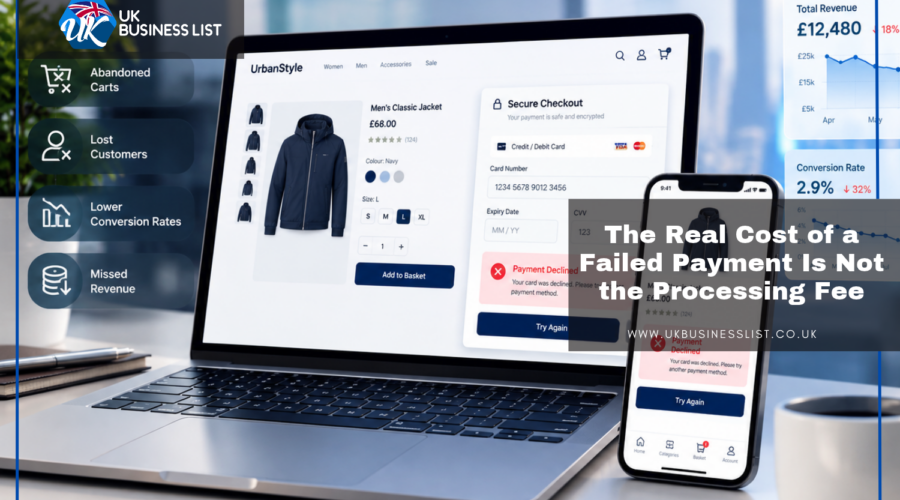
The Real Cost of a Failed Payment is not the Processing Fee
A shopper adds a jacket to their basket, reaches the checkout, and the card is declined. No error message worth reading, no retry prompt, just a blank refusal.
For the merchant, the ledger shows nothing: no fee, no revenue, no line item at all. That absence is the problem. A £68 sale vanished, and the accounting software has no box to record why.
Multiply that single decline across a mid-sized UK retailer processing four thousand transactions a month, and the pattern turns expensive fast.
Why a Decline Reads as Silence, Not as Data
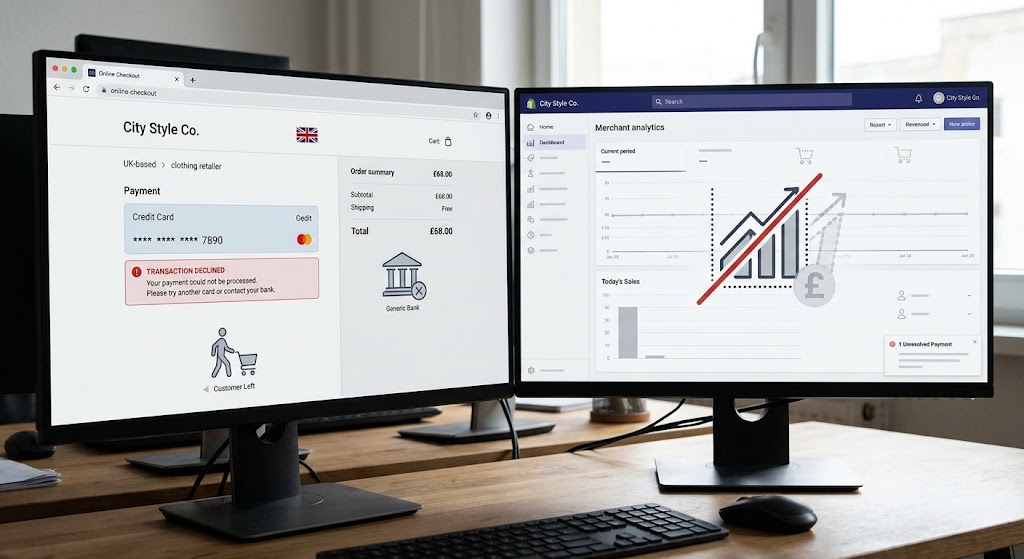
Industry estimates put false declines – legitimate customers wrongly blocked – at roughly 5 to 9 percent of attempted card payments, several times higher than actual fraud losses.
Businesses that route transactions through capable payment processing services instead of a single acquiring bank tend to recover a meaningful slice of that volume, because the routing logic retries through a different rail before giving up on the customer entirely.
Most finance teams track chargebacks closely because a chargeback arrives with paperwork attached. A decline arrives with nothing. The customer simply leaves, and unless the checkout software logs the failure reason – insufficient funds, an expired card, a mismatched postcode, a bank’s own fraud filter – the business never learns what happened.
A 2024 survey of European e-commerce operators found that under a third could break down their own decline reasons by category, which means two-thirds are guessing at a fix for a problem they can’t describe.
That blind spot compounds. A customer who fails once at checkout doesn’t file a complaint; they open a competitor’s site in a second tab. The lost sale never shows up as a support ticket, a review, or a refund request. It shows up only as a dent in the conversion rate that a marketing team then tries to fix with a discount code, treating a payment failure as a pricing problem.
Where the Hidden Costs Actually Sit
| Cost category | What triggers it | Typical impact |
| Lost first sale | Decline at checkout, no retry | 5-9% of attempted transactions |
| Customer churn | Repeated failures on the same card | Up to 40% never return |
| Support overhead | Manual investigation of failed orders | 15–30 minutes per case |
| Retry infrastructure | Building routing logic in-house | 6-12 months engineering time |
| Currency mismatch fees | Cross-border cards charged in wrong currency | 2-4% margin loss |
Retail finance directors often build their loss forecasts around the top row and stop there, because it’s the only number the payment gateway’s dashboard surfaces by default. The other four rows live in support tickets, engineering sprints, and currency conversion statements that nobody cross-references against checkout data.
A practical routing setup narrows most of that table down to one or two lines instead of five. The sequence a mature system follows usually looks like this:
- Attempt the transaction through the customer’s preferred local rail first.
- A decline triggers an instant retry through a second acquirer, before the customer notices anything went wrong.
- Flag currency mismatches before authorisation, not after settlement.
- Route repeat failures on the same card to a fallback method automatically.
- Log every decline reason for the finance team to review weekly.
How Businesses Are Closing the Gap
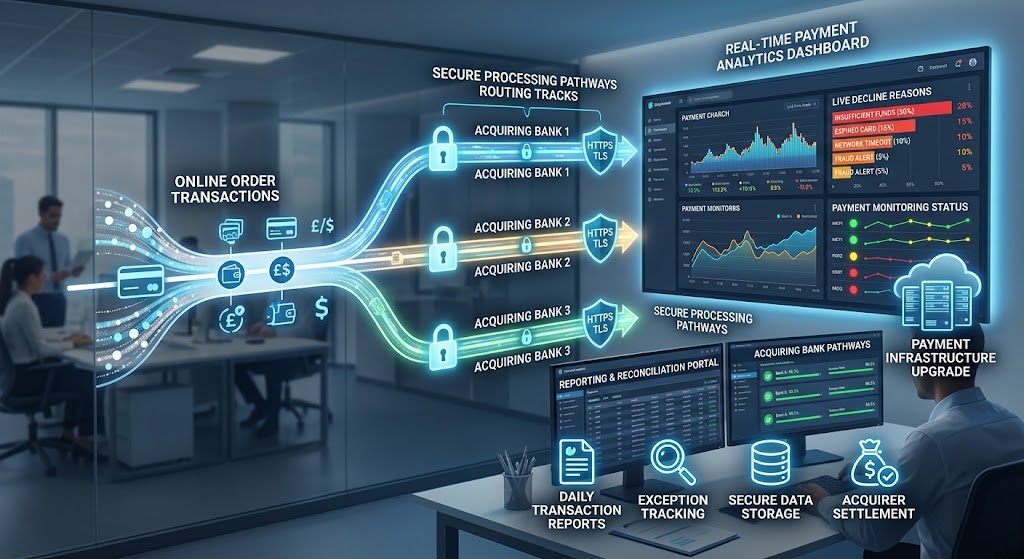
Two changes tend to move the needle before anything else does: better visibility into why payments fail, and enough rail diversity that one failure doesn’t end the transaction.
Neither is a one-off fix. A merchant that adds a second acquirer but keeps the same manual reconciliation process usually just doubles the paperwork instead of halving the losses. The gains show up when routing, reconciliation and reporting are treated as one connected system rather than three separate purchases from three separate vendors.
- Map every decline code to a plain-language reason before building any fix.
- Test at least two acquiring banks per major market, not one.
- Review currency settlement reports monthly, not at year-end.
Smart Routing and Cascading
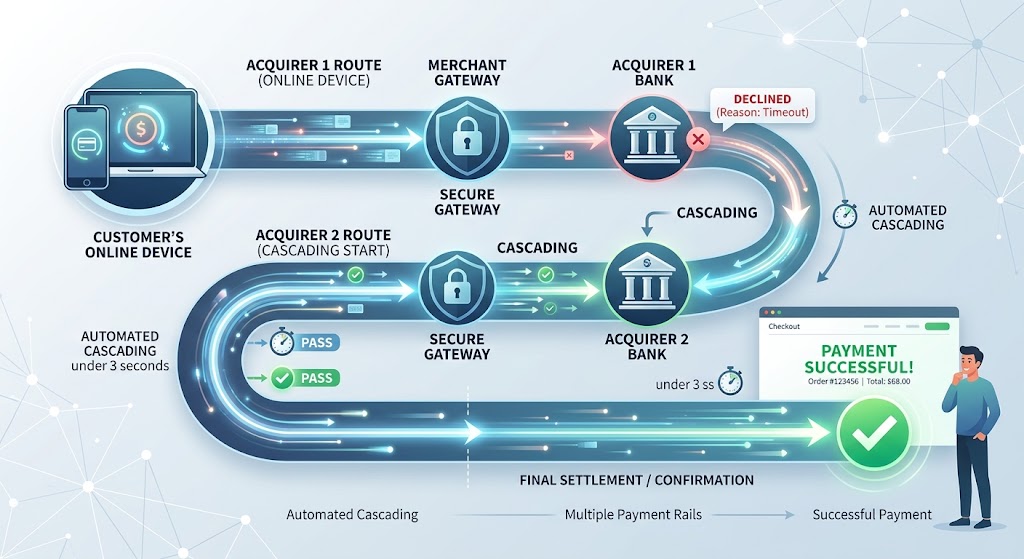
Cascading works by trying a second acquirer automatically within the same checkout session, usually within two to three seconds, so the customer never sees the first failure. A UK homeware retailer that added cascading logic reported a 22 percent recovery rate on transactions that would otherwise have failed outright, without changing a single price on the site. The mechanic is unglamorous: it’s plumbing, not marketing, and that’s exactly why it works.
Local Rails and Currency Coverage
A card issued in Poland processed through a UK-only gateway can fail even when the account is fully funded – currency mismatch and issuer risk rules are common culprits. Supporting local rails such as SEPA transfers or country-specific card schemes alongside the standard card network cuts that category of failure sharply for any business selling across borders, because the transaction never has to cross a currency boundary it wasn’t built to handle.

Passionate content designer, contributor and content marketing allrounder at ClickDo.