
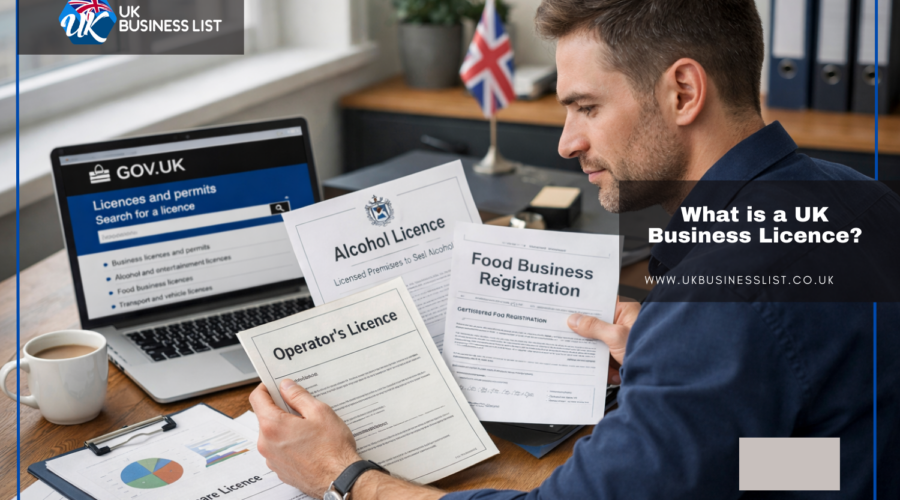
What is a UK Business Licence?
In the UK, a business licence is an official permit that allows a company or individual to carry out certain activities that are regulated by law.
Local councils and central government departments issue licences for activities like selling alcohol, trading in the street or running a childminding business.
For most UK businesses, no general “business licence” is required unless your trade is specifically regulated.
Also read: What is a registered business address
Common Types of Business Licences in the UK

The UK has over 450 different types of licences and permits, many of which are managed at the local level.
Some of the most common include:
- Alcohol Sales: If you want to sell alcohol, you must obtain a premises licence (for the location). Additionally, every alcohol-licensed venue must have a Designated Premises Supervisor (DPS) who holds a Personal Licence. These are managed by local authorities under the Licensing Act 2003. (GOV.UK Alcohol Licensing)
- Food Business Registration: All businesses that prepare, store, or sell food must register with their local council at least 28 days before they start trading. This process is mandatory and typically free, but regular food hygiene inspections follow. (Food Standards Agency)
- Taxi & Private Hire Licences: Taxis and private hire vehicles need separate licences for drivers, vehicles, and operators. Local councils issue these across England, Wales, and Scotland.
- HGV Operators: Companies operating heavy goods vehicles (HGVs) for commercial haulage must obtain an Operator’s Licence. (O Licence)
- Street Trading/Market Stalls: Selling goods or services in public areas (markets, streets) requires a street trading licence from your council. (GOV.UK)
- Childcare/Nurseries: Nurseries and childminders are regulated by Ofsted in England, or the equivalent in Scotland, Wales, or Northern Ireland. (Ofsted)
- Financial Services: Businesses offering financial products, advice, or lending must be authorised by the Financial Conduct Authority. (FCA)
- Gambling, Security, and Other Sectors: Gambling businesses require a Gambling Commission licence. (Gambling Commission)
Who Issues Business Licences in the UK?

Licensing governance is distributed across a multi-layered regulatory environment:
- Local Authorities: District, unitary, and metropolitan borough councils issue the vast majority of operational permissions.
- National Regulators: Specialized sectors are managed by national agencies to ensure uniformity. The Financial Conduct Authority (FCA) regulates firms in financial markets, while the Gambling Commission regulates the commercial gambling industry.
- Traffic Commissioners: These independent regulators are responsible for licensing and regulating HGV and PSV (Public Service Vehicle) operators and their drivers.
Business Licence Statistics: UK Snapshot
The scale of the UK’s regulated commercial environment is reflected in recent authority reports:
- As of March 2024, there were 224,100 premises licences and 900,300 personal licences in issue across England and Wales. (GOV.UK)
- As of early 2025, there were 66,222 valid goods vehicle operator licences authorised in the UK. (GOV.UK)
- On 31 August 2025, 60,000 childcare providers were registered with Ofsted, though this figure represents a 2% decline due to a long-term fall in the number of childminders. (GOV.UK)
The UK’s licensing environment is currently undergoing a period of modernization.
A major development in 2025 was the industry-led Licensing Taskforce report, which provided 10 priority recommendations to the government to reduce bureaucratic “red tape”.
Key proposals include the creation of a National Licensing Policy Framework to reduce the “postcode lottery” of inconsistent local decisions and a one-off licence amnesty to remove outdated conditions from existing permissions. (National Licensing Policy Framework – Policy Paper)
Furthermore, the government is introducing the “Agent of Change” principle into national planning and licensing policy. (GOV.UK – Press Release)
As of July 2025, this requires developers building near existing music venues or pubs to be responsible for soundproofing their new buildings.
Important Resources and Tools
Please let us know if you have more information you’d like to share about this subject.
Disclaimer: All the information provided was correct at the time of publication and was collected with the help of accredited tools and AI.

Covering unique UK business stories, business advice and news to keep the UK Business List audience informed!